


Social sciences among the winners of 2005 Descartes Prize
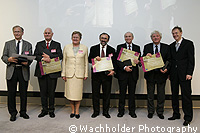
The five winners of this year's one million euro Descartes Research Prize were announced at a ceremony at the Royal Society in London on 2 December, and included the first team of social scientists to be recognised with the EU's highest scientific honour. The European Social Survey (ESS), led by Professor Roger Jowell from City University London, has developed a unique scientific methodology for mapping changes in social attitudes and behaviour in 26 European countries, providing an authoritative source of EU data for academics and policy makers. The other four Descartes Laureates were drawn from the fields of materials science, climate change, astronomy and disease management. After collecting the prize on behalf of the ESS team, Professor Jowell told CORDIS News: 'This prize is extremely important for the social sciences. Just five years ago it would have been inconceivable for a major award to go to a team working in this field, and this reflects the development that has been achieved in the social sciences.' The four other winning teams, who also claimed 200,000 euro in prize money along with ESS, were: EXEL, which has developed a new class of materials (known as left-handed of negative index materials) that overturn many of the familiar properties of light; CECA, for breakthrough research on climate change in the Arctic region; PULSE, for demonstrating the impact of pulsar science on modern physics, including the discovery of the first double pulsar; and EURO-PID, for cutting edge research on a group of over 130 rare genetic diseases. Presenting the awards, European Science and Research Commissioner Janez Potocnik said: 'The teams present here today are not just representing the best scientists and engineers of our generation. They are the living proof that high-quality research can only be achieved by putting together brilliant minds and high-level skills, as well as equipments and infrastructures. This would not have been easily feasible in one country alone.' Also awarded at the ceremony in London was the 2005 Descartes Prize for Science Communication, which now in its second year. Again, the prize was shared between five winners, who each collected 50,000 euro. In the category of professional scientists engaged in science communication to the public, Carl Johan Sundberg - Sweden's 'Mr Science' - was recognised for over 20 years of activities including, most recently, establishing the Euroscience Open Forum. In the same category, astrophysicist Anja Andersen, from the Dark Cosmology Centre at Copenhagen University, was rewarded for her work in the Danish media and for her commitment to stimulating young people's interest in science, particularly young women. Accepting her award, Dr Andersen said: 'I was often advised by older colleagues to stop doing public outreach activities, as it can be looked down upon when applying for permanent jobs. That's why this award is so nice - it says 'yes'!' Jos Van Hemelrijck, producer of weekly Belgian TV show 'Overleven', which sheds light on how scientists go about their work, was presented with the award for popularising science through audiovisual and electronic media. For 'innovative action for science communication', Michael Seifert from Tübingen University was recognised for his role in setting up the 'Kinder-Uni', or children's university, which organises lectures for children aged eight to 12 interested in studying science and has inspired similar initiatives across Germany and beyond. Finally, the award for popularising science through the written word went to the bestselling author Bill Bryson, for his 2003 book 'A Short History of Nearly Everything', which tackles subjects ranging from the big bang to the rise of human civilisation. After receiving his prize, Mr Bryson joked: 'I can't imagine that anyone has ever been more generously rewarded for his ignorance.' The author admitted to having been confused and bored by science at school, 'but I was convinced that it must be interesting. Writing the book, two things stuck in my mind - science is amazingly interesting and important, and scientists are wonderful people, apparently without exception.' For both categories in this year's Descartes Prize, the Laureates were selected from a record number of nominations. As well as the five winners in each category, five finalists were also rewarded for the first time, claiming 30,000 euro each in the collaborative research category and 5,000 euro in the science communication field. The Chair of the Grand Jury, President of the Estonian Parliament Ene Ergma, said that the awarding policy had changed for this year's prize, with a maximum of five winners in each category compared with the usual two or three, thanks to the sheer number of excellent projects vying for the awards. 'The members of the Grand Jury would like to propose to the Commission to discuss the possibility of increasing the number of Descartes Prizes [for collaborative research] from one to four, together with an increase in the sum of prize money,' said Professor Ergma. Later, Professor Ergma told CORDIS News: 'We don't want to divide one million euro by five, as big prizes means the prize is more prestigious. We agree with the Commission that we needed to see how the prize worked out in practice, but now it has proved itself, and I think that four categories of prizes of one million euro each would be fitting.'