


Verheugen calls for increased cooperation in European security research
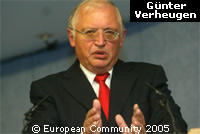
EU Commissioner for Enterprise and Industry, Günter Verheugen, has called for increased cooperation in security research - both in terms of civil and defence related security research, and between national and European actors. Speaking at the Research and Technology Conference in Brussels on 9 February, where representatives from the Commission, the European Defence Agency (EDA), Member States and industry were meeting to discuss a joint approach to security research, Mr Verheugen accepted that the issue of security policies in Europe is still a delicate one. 'Nevertheless, one has to realise that in real life, operations of the civil security sector and the military sector resemble each other - and increasingly so. Thus the current split of research domains appears sometimes artificial, especially when viewed at the technology level,' he argued. The Brussels conference was organised following a request by Member State leaders at their Hampton Court Summit in October 2005 for the head of EDA, Javier Solana, to make proposals on how to boost European defence research and technology. For Mr Verheugen, the answer is clear: 'We have to join forces,' he said. 'Both the Commission and EDA are currently working on long-term strategic research agendas for 'their' security research domains. [...] In research, we need innovative approaches, we need to avoid harmful research gaps and unnecessary duplication. What we need is coordination between the [two] security research agendas.' As well as coordination at European level, Mr Verheugen pointed to the significant amounts of security research carried out nationally, inevitably resulting in overlaps and fragmentation. However, as no appropriate mechanisms exist to coordinate these efforts solutions must be developed over the coming months, he said. These views were echoed by the President of ASD, the AeroSpace and Defence industries association in Europe, Tom Enders. Mr Enders proposed a number of instruments for strengthening Europe's profile in defence research, including the establishment of a dedicated technology board, the creation of a 'technology incubator', and the setting up of an EU-wide network of centres of excellence. 'So far, we have seen many initiatives but little action,' he added. The Commissioner concluded: 'Europe is at the dawn of establishing its own security identity and security culture. No Member State will have to abandon part of its sovereign rights, but all Member States will have to contribute to building this European security culture together.' Mr Solana supported the ideas expressed by Mr Verheugen. Pondering how Europe can bring about a step-change in its defence research efforts, he said: 'I am convinced we must do three things: first, spend more [...]; second, we must spend better [...]; third, and perhaps most important, we must spend more together.' During the conference representatives from the defence industry called for the proportion of research and technology spending that is invested collaboratively in Europe to be increased from the current level of less than 5 per cent to 20 per cent. While Mr Solana agreed that providing a substantial research and technology budget to the EDA would be one possible way to achieve this objective, he concluded by emphasising that agreeing on the principle of a joint fund matters more than the mechanism for investing it. European defence ministers will discuss ideas for increasing defence research spending, including the option of creating a fund under the control of the EDA, at a meeting in Innsbruck on 7 March. Those discussions are expected to lay the ground for possible decisions in the June European Council.