


Schenkel stresses the importance of robust science for policy-making
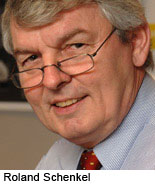
'Robust science for policy-making' - this is the new positioning statement of Directorate-General Joint Research Centre (DG JRC). Dr Roland Schenkel, Director-General, elucidated this approach in the context of the entire EU policy cycle. He highlighted the indispensability of DG JRC as a customer-driven, impartial and flexible in-house research organisation. DG JRC is about to celebrate its 50th anniversary, having been created under the Euratom Treaty in 1957. A Directorate-General of the European Commission, it comprises today 2,650 scientific and support staff located across seven Institutes in five Member States - Belgium, Germany, Spain, Italy and the Netherlands. Its role is to provide other DGs and European institutions such as the Council or Parliament with the research they need for policy-making in areas such as: food safety, chemical products and health; environment and sustainability; nuclear safety and security; technology foresight; reference materials and measurements; public security and antifraud. 'It is important to note that we are not a policy-making DG,' emphasised Dr Schenkel. 'Our support spans the complete EU policy cycle from anticipation to formulation and adoption; implementation to compliance and impact assessment. While our main customers are in the Commission, we now also receive more requests from the European Parliament [EP], Council and individual Member States. I think this is in the original spirit of our organisation.' Dr Schenkel outlined a number of reasons why DG JRC is experiencing growing demand for its services, starting with the organisation's independence. 'First of all, scientific expertise is playing an increasing role in the legislative process worldwide. Policy-makers want to know the facts and to receive independent advice. This is not always obvious when they are increasingly faced with having to balance different opinions and so many claims and counter claims from interest groups. They need somebody impartial to look at the bare scientific facts, and uncertainties, to make comparisons and carry out additional research, if necessary. That is why DG JRC serves the common interest of the Member States, while being independent of special interests, whether private or national. It's a balance that works.' In the early part of the EU policy-making process, customer DGs in the Commission can ask DG JRC for studies on sensitive scientific areas - such as emerging technologies - and the opportunities and potential risks involved. One example is DG JRC's recent study commissioned by the EP on biometrics, an area driven by increasing security needs but also raising EU citizen concerns about privacy issues. Based on the relevant data, the next question is whether EU legislation is needed in a particular field in order to protect the citizen. DG JRC is called upon to provide feasibility studies and impact assessments, for example, on the thresholds of genetically modified organisms (GMOs) in seeds and protective measures needed to ensure coexistence of GMO and non-GMO agricultural plants. Coming closer to the adoption of legislation, the focus of DG JRC shifts to the elaboration of standard testing methods and technologies to control the thresholds which are defined in the legislation. As soon as the legislation is in force, DG JRC is then involved in the control, feedback and compliance circle. 'In many areas at European level you need controls to check that legislation is implemented in a proper way and this is where we are heavily involved,' Dr Schenkel underlined. For example, DG JRC uses satellite technology to monitor whether crops and land use in the Member States meet the common agricultural policy (CAP) requirements concerning subsidies and that there are no irregularities. In the area of nuclear non-proliferation, DG JRC assists the Commission, international bodies such as the International Atomic Energy Agency (IAEA) and national authorities in the control of nuclear materials. 'We give scientific-technical support for upgrading nuclear facilities in eastern Europe and the Commonwealth of Independent States.' DG JRC is also called upon by national authorities to help with determining the nature and origin of stolen or diverted nuclear materials. 'Our mission is also to provide comparative analysis and the best possible support,' Dr Schenkel highlighted. He mentioned the example of a study on energy supply which DG JRC is carrying out on behalf of the EP. 'What the EP needs is not just another opinion-based input but an objective and comparative analysis of all data and scenarios provided by different stakeholders. DG JRC's conclusions provide a reasonable and realistic basis for EU decisions in the field and this applies to other areas where sensitive scientific issues are relevant for policy-makers.' The Director-General also emphasised the confidentiality aspect of DG JRC. 'When exchanging certain highly sensitive data from one DG to another, our colleagues know that confidentiality is assured and that this information will go no further.' Another advantage is the fast, direct and easily accessible support that DG JRC provides on request. This is not only when facing immediate crisis situations but also in their aftermath, when compensation claims need to be accurately assessed, as was the case following forest fires in Portugal and a wind storm in Slovakia. 'We have recently helped develop a new pan-European flood alert system that is proven to greatly increase the warning time given to national authorities and are currently working on a similar drought alert system.' Examples in the external policy area include tsunami flooding and the earthquake in Pakistan where DG JRC immediately came into play, providing reliable satellite data on which the services which are responsible for humanitarian aid could plan their responses. In light of this broad range of activities and the involvement of DG JRC at the various stages in the EU policy cycle, Dr Schenkel also expressed his appreciation of the strong customer satisfaction and high approval rating across EU institutions and Member States. 'The new Member States and candidate countries know our work well, as we work closely with them on taking up the scientific and technical aspects of EU legislation. In 2005, for example, we organised 102 workshops and training courses involving over 4,000 experts.' 'This is also the best motivation for our staff,' Dr Schenkel noted. It is part of the customer-driven mission to deliver high-quality results in the expected timeframe - which is not always easy in a research organisation. But visitors to the research institutes are most impressed by the enthusiasm of our people. This is also why Dr Schenkel tries to visit the institutes as often as possible: 'I want to meet the staff, learn about their achievements and get a feeling of this positive spirit driving DG JRC as a learning organisation.' On Saturday 13 May 2006, for example, DG JRC organised its annual Open Day at its site in Ispra, Italy with over 3,500 members of the public. 'To see people of all ages and bus loads of children visiting our laboratories and meeting with scientists, participating in experiments and having a fun day out, I could think of no better example of [Commission] Vice-President Wallström's action plan on improving communication.' Dr Schenkel also welcomes the composition of DG JRC personnel with 65 per cent permanent and 35 per cent mobile staff such as grant holders and visiting scientists - which he thinks is extremely important for competence building and competitiveness. DG JRC needs this spread and inflow of new ideas as well as the personal exchange of established experts with young people. 'When we get requests from customers in new areas where we may not have sufficient competence we can attract new experts. It is essential to have this flexibility and critical mass.' Attentive to the personal needs of staff in non-central locations, DG JRC has also started to improve crèche facilities in order to make a job with DG JRC even more attractive to young researchers. Asked about priorities in the coming years, Dr Schenkel referred to the DG JRC draft programme in the context of the Seventh Framework Programme (FP7). 'Strong support of the new Member Sates and candidate countries was a real priority and big success in recent years and this will also continue under FP7. We don't need to grow, we need to adapt and prioritise, to strengthen competitiveness,' he added. 'For FP7, there will be increasing emphasis on safety and security issues. Major topics include security of energy supply, terrorist threats and non-proliferation. The other growing areas are sustainable agriculture and quantitative and qualitative analysis of policies in the framework of the Lisbon agenda.' A good example here is the annual Industrial R & D (research and development) Investment Scoreboard realised for DG Research based on the audited reports and accounts of the top 700 EU and 700 non-EU corporate R & D investors. Hi-tech research carried out by DG JRC is much in demand. Not only does DG JRC contribute to Earth observation programmes like global monitoring for environment and security (GMES: a concerted effort to bring data and information providers together with users, so as to make environmental and security-related information available to decision-makers when they need it), it also has the tools to detect suspicious money flows and to carry out searches on the publicly available Internet. For example, the European media monitor (EMM) is being used by Health and Consumer Protection DG to monitor outbreaks of disease based on published reports. There is also a renewed interest in energy sources. 'What you have to bear in mind is that a secure energy supply for the EU means that all energy sources need to be considered,' Dr Schenkel emphasised. 'We have state-of-the-art facilities for safety testing of hydrogen storage and for performance testing of fuel cells and solar cells. The overall objective of our non-nuclear-energy work programme is to contribute to the establishment of a carbon-lean, hydrogen-inclusive energy economy in the European Union, which is sustainable, competitive and increasingly self-sufficient.' Nuclear research will remain an important activity of DG JRC, which was appointed in January 2006 as implementing agent of Euratom's participation in the Generation IV International Forum initiative. This aims at developing innovative nuclear systems that answer better to environmental and economic criteria and public opinion concerns. 'We will focus on nuclear safety and security, non-proliferation and the management of highly active waste,' Dr Schenkel added. 'We will coordinate the European contribution to the development of future nuclear energy systems which are safer, more competitive, produce less long-life wastes and are more sustainable.' Dr Schenkel further explained that DG JRC reduces some efforts, typically in areas for which deliverables have been finished, and the transfer of technologies to clients who will then operate them. 'It's a fine balancing act between painstaking research that might take us years to build up capabilities and fast, flexible solutions to immediate problems. We can't afford to sit still. Listening closely to our customers, understanding their needs and responding in time is our strength. We also strive to avoid duplication with national research centres, to work side by side and to build synergies.' Dr Schenkel ended by highlighting the close correlation between the work of the Commission's in-house research organisation and the well-being of the citizen. 'We don't aspire to cover all areas of research but in the areas where it matters most, from monitoring levels of potentially harmful chemicals in shampoo or cigarette smoke to the actual nutritional value of organic food; to developing alternatives to animal testing in laboratories or to certifying the performances of renewable energy products on the market, we are making a difference.'