


EU research initiatives address challenges posed by growing aeronautics sector
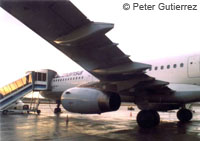
The fifth 'Aeronautics Days' event has been held in the Austrian capital, Vienna, with the EU Commissioner for Science and Research, Janez Potocnik, reaffirming his commitment to the aeronautics industry, and assuring delegates that the Seventh Framework Programme (FP7) is on track to start in early 2007. The Commissioner was one of the Aerodays' introductory speakers. He paid tribute to the Austrian nation, which has increased its turnover in aeronautics from just EUR 30 million in 1998 to EUR 500 million today. The day also showcased two major research initiatives which have the full support of the European Commission - one on the future of air traffic control and another on minimising emissions. Europe currently carries 25,000 flights per day, supporting some 3.1 million jobs in transporting a billion passengers per year. There are 4,500 flights in the air at any given moment. By 2020, there will need to be an extra 14,000 new aeroplanes to support the rise in demand for flights. This represents both an enormous opportunity for business and an enormous potential threat to the environment. 'The importance of aeronautics is huge,' said Commissioner Potocnik. 'Aeronautics is the most important component of the transport section of FP7, and the third overall in the future,' he said. A total of EUR 4.2 billion has been set aside for continued research into transport under FP7. For aeronautical engineering, the bulk of decision-making has been handed to the Advisory Council for Aeronautical Research in Europe (ACARE), which was the first active European Technology Platform (ETP). ACARE's strategic research agenda now informs the outline of the aeronautics component for research under FP7. Another ACARE area, CLEAN SKY, is a likely candidate to be developed into a Joint Technology Initiative (JTI). CLEAR SKY aims to significantly reduce the environmental impact of aeroplanes, both in the emissions they produce and in the noise they make. Eduard Manioni, the Austrian Secretary of State for Research said that the aeronautical industry was key, and that support of it, and Lisbon Agenda goals would be essential. 'Annual growth rates of five per cent make the aeronautical industry one of the fastest in the world. It is a research-intensive industry, and with 14 per cent of turnover put into R&D [research and development] there is a commitment to sustainability,' he said. Carriers are already responding to demand, driven by much increased competition since the September 11 attacks on New York in 2001, which decimated customer demand. Since then, Victor Aguado, Director General of Eurocontrol, pointed out that in recent years, demand has increased, delays have fallen, safety has increased and costs have fallen - a win-win for everyone. But, to make the most of the increases in aircraft use, there has to be a corresponding increase in the capacity of the skies. Eurocontrol's SESAR project aims to make this a reality, maximising the use of the sky for safer and more dynamic air traffic use. 'It is the air traffic management master plan,' he said. SESAR will use the same technology as the EU's satellite navigation programme, Galileo, and coordinate the European air traffic control systems. The significantly heightened accuracy of Galileo should make flying increasingly safe. The project supports the Commission's Single Sky Directive set in 2004. This continued support for aeronautics is not a new phenomenon, but a development of established research. 'The EU started to support aerospace in 1988,' said Commissioner Potocnik. 'The industry must retain this dynamism for the future,' he said. Sustainability is key. 'It is one of the most technically intensive sectors, with 14 per cent of turnover put into R&D, and strategy is important for the future of Europe.' 'The political support for European R&D reached new heights when the Heads of State and Government endorsed the revised Lisbon strategy, putting knowledge and innovation for growth as the first priority for the EU. There is now a commitment to invest more heavily in this area,' he said. German MEP Jorgo Chatzimarkakis agreed, saying that, 'We are one of the best in invention, but not in innovation - we do not understand innovation. Research is money to technology, and innovation is technology to money.' He referred to key European inventions, like the Internet and the MP3 format, which have failed to be exploited sufficiently in Europe. Commissioner Potocnik is a strong advocate of European innovation, and particular the blueprint for innovation authored by the expert group, chaired by former Finnish Prime Minister, Esko Aho. While all R&D contributes to meeting Lisbon agenda targets, three per cent does seem a way off. Europe's aeronautical industry is a world leader, with only the US company, Boeing, with the resources and scope to compete. 'Accordingly, the high level of investment in R&D achieved in the Aeronautics sector has to be maintained - if not increased - in order to consolidate the industry's leading advantage,' said the Commissioner. FP7 launches new and exciting areas for research in the EU. As the EU expands, so an efficient transport infrastructure is essential. The 'Vision 2020' report, and the EU's transport white paper were key influences on ACARE's list of priorities for research. This research agenda leads Europe's thinking and research priorities, which has to innovate in this enormously competitive industry. The key areas identified are: - increasing capacity - to respond to demand which is expected to double over the next 10-15 years, but triple over the coming 20 years; - the 'greening' of air transport - this increased demand will place pressures on aeronautics manufacturers to reduce emissions and environmental impact; - aircraft and passenger safety - specifically to address terrorist actions, as well as airspace management; - cost efficiency - reducing the time to market of new technologies will in turn reduce the costs across the entire industry, making air transport more affordable; - consumer satisfaction - to reduce the number of accidents five-fold and increase the satisfaction of passengers, including round-the-clock airport use, using quieter aircraft to mitigate environmental and noise impact. - Time efficiency - to make better use of the air space, which will increase prompt take-off and landing as well as reduce the time spent in airports. - Future air transport - looking for new ways to increase the experience of future air passengers, and find radical, innovative solutions. As to when FP7 would actually start, the Commissioner was emphatic. 'Let me assure you that all Institutions involved - Council, Parliament and Commission, are committed to adopt the Framework Programme legislative package as soon as possible. Following a second reading in the European Parliament in the autumn and final adoption by the college, FP7 should be ready to start up at the very beginning of 2007.' He summed-up by saying that he would remain a frequent-flyer, both on the industry's airlines and in the ongoing research initiatives. The figure of the Airbus A380 loomed very large over proceedings, with a profits warning issued by lead partner EADS, and the imminent arrival of American president George W Bush.