


Finland makes early start on upgrading innovation policy with roadmap
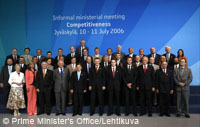
When Finland, one of the world's most innovative countries, announced that innovation would be one of the key themes of its EU Presidency, expectations were immediately raised. Only 10 days into the Presidency, Finland has not disappointed, holding an informal Competitiveness Council, resulting in a roadmap to address the innovation challenge. The meeting was no talking shop. Council Chair and Finnish Minister for Trade and Industry Mauri Pekkarinen had ministers 'rolling up their sleeves' and working in small groups. Innovation experts were also invited to address the ministers. 'As the EU Presidency, Finland has no 'magic bullet' to offer in order to build a new, more innovative, productive and competitive Europe,' warned Mr Pekkarinen at the start of the meeting. By the end of the two-day meeting, it seemed that the other EU Member States were behind Finland's views on how to make Europe more innovative. 'The European innovation policy needs a wider perspective, and the discussions gave strong support to the broad-based innovation policy proposed by Finland,' said Mr Pekkarinen in his concluding remarks. The minister described how the meeting had thrown up a few themes that would need further consideration in the autumn, and that it is still too early to go into detail on how the new broad-based innovation policy should look. However, Mr Pekkarinen was in a position to outline a roadmap on 'the content of the future challenge'. Mr Pekkarinen divided actions into three 'baskets': regulatory issues; innovation funding; and institutions for producing innovation. In the first basket is the need to make internal markets more efficient, as well as implement an efficient patent system, promote better regulation, reform state aid rules, use public procurement to promote innovation, and review the public sector's ability to provide services. On innovation funding, the minister called for Structural Funds to be used to finance innovation; for Member States to increase funding for European Technology Platforms; and a Community-wide market for venture capital. Explaining why 'institutions for producing innovation' should be a third priority category, Mr Pekkarinen stressed the need for more and better partnerships between universities and businesses, mechanisms to disseminate research and business partnerships best practice, and a European Institute of Technology (EIT). 'Equipped with a network structure, it could provide an instrument for improving the European research community's competitiveness,' he said on the EIT. Mr Pekkarinen pledged that Finland would work closely with the European Commission and future EU Presidencies in order to develop the innovation theme. The presence of several representatives from industry at the Council also suggests that Finland will involve stakeholders in discussions. One of those present at the meeting was Jorma Ollila, Chairman of Nokia. He echoed much of what his minister said on the challenges, adding one of his own - the low adoption of information and communication technology (ICT). He also narrowed down what needs to be done into three specific actions on Technology Platforms, state aid rules and the regulatory framework. Mr Ollila is a prominent supporter of European Technology Platforms - his company is involved in four. 'The challenge here is to find sufficient commitment and funding to launch the most advanced Technology Platforms without any further delay - specifically, within six months from now. Some of them may find their way into the Seventh R&D [research and development] Framework Programme as Joint Technology Initiatives, but this is not enough and should not be the only way forward,' said the Nokia Chairman. 'Our commitment is clear: we are ready to invest in Europe exactly as the Lisbon and Barcelona processes suggest; now it is the time for governments in Europe to deliver,' he said. Mr Ollila then called on the EU Member States to commit to funding between three and five advanced Technology Platforms by the end of the year. On state aid rules, Mr Ollila underlined the importance of having, 'a level playing field in the increasingly more global landscape, in order to establish conditions for fair competition'. Rules are currently under review by the Commission, but according to Mr Ollila, 'The provisions as planned don't fully respect the characteristics of the knowledge economy and the interactive nature of innovation. Instead of looking at the type of research or the recipient, public R&D funding should support the creation of knowledge networks and public/private partnerships. Expert panels and industry have proposed that the EU should adopt generic rules that sanction only 50 per cent of R&D state aid intensity at the programme level.' The fragmentation of support schemes used throughout Europe also make it 'virtually impossible' to create international networks of critical scale, he added. Mr Ollila's proposal therefore is that the EU adopts state aid rules that provide it with 'a strong arsenal to respond effectively to increasing competition in global markets while keeping a close eye on promoting fair competition at home'. The Nokia Chairman's third proposal was for governments to agree on the policies to provide regulatory certainty, in particular for commercial launches of mobile broadcasting, and for creating new business opportunities and lead markets in the mobile TV sector. The discussions on innovation are set to continue in the autumn, and the Finnish Presidency's ultimate goal is to 'place discussion on innovation policy as a permanent part of the European competitiveness agenda and identify key elements for follow-up to be taken forward by future Presidencies'.
Countries
Finland