


German students' eco-car a highlight at ESOF
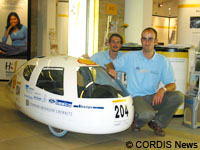
Every year, a fleet of strange looking vehicles gathers to take part in an unusual race - the Shell eco-marathon. The goal is simple: to drive as far as possible using the least amount of energy. One of the cars that participated in the 2005 and 2006 races was on display at ESOF2006. In 2006 the 'Fortis Saxonia' team came an impressive 12th out of over 200 teams in the race, with a fuel consumption of 1,742 km/L. The team also came second in the Shell Communication Award for its impressive work raising awareness of the competition across Germany, and won third prize in the technical innovation category. What started as a student research project at the Chemnitz University of Technology now involves 20 students from a number of institutions, most of whom are studying mechanical engineering, electrical and electronic engineering and information technology (IT). They also have a number of technology sponsors whose logos are plastered all over the car. The car itself is powered by a hydrogen fuel cell. According to team member Dirk Dietrich, the team's success can be attributed to a combination of factors. 'It has to fit together. You have to be lightweight, you need to have a really efficient transmission, an efficient fuel cell and an efficient electrical engine in our case. With all this together you can reach high positions,' he told CORDIS News. The average speed of the car in the race is 30km/h, which is the minimum average speed required to compete in the race. Its top speed is 45 km/h. In such a small vehicle, the weight of the driver is also important; their car is driven by a woman who weighs 50 kg, which is the minimum driver weight set down in the race rules. The team plans to construct an entirely new car for the 2007 race. What kind of changes will the team make to the design? 'It will be even smaller from the front to reduce windforce and will be more lightweight,' replied Mr Dietrich. 'If you look at other teams, the cars are much smaller; this is a big one.' With these and other improvements the team is hoping to make it to the top five. Meanwhile the students are showing off the current car at science fairs, before handing it over to their sponsors for display in their offices.
Countries
Germany