


Envisat data reveals birth of ocean
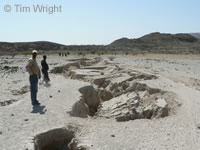
A recent crack in the Earth's surface some 60km long is evidence of rapid tectonic shift, and could open an area of Ethiopia and Eritrea to the Red Sea, cutting it off from the rest of Africa, according to new research using the European Space Agency's Envisat satellite. In September 2005, a series of more than 100 extremely powerful earthquakes and other volcanic activity in the Afar valley opened a long, thin gash on the Earth's surface. This gash was a result of sudden tectonic movement 5km beneath the surface, as the Arabian plate pulled away from the African Somalian and Nubian plates. The team, from the UK, the US and Ethiopia, examined the ground in this dry and remote area using information from the European Space Agency's Envisat satellite using interferometric Synthetic aperture radar (InSAR) data. The satellite takes highly accurate radar 'pictures' of the Earth's surface. If a researcher needs to compare how the earth may have moved, then new pictures are compared to baseline pictures, and then one subtracted from the other. Areas where the pictures are identical, there is no reading, but changes of the order of millimetres can be detected. The results were compelling. Magma - liquid volcanic rock - collected in areas 2 to 9km below the Afar Valley. Instead of moving to the surface, where it could have been released by the Gabho or Dabbahu volcanoes, the magma moved north-south, creating in a subterranean dyke around 60 km long. This magma dyke caused the tensions between the tectonic plates to give way. The Envisat technology was crucial to discovering the underlying causes of the event. Professor Cindy Ebinger is part of the team, from Royal Holloway, University of London. 'It's amazing. It's the first large event we have seen like this in a rift zone since the advent of some of the space-based techniques we're now using. These techniques give us a resolution and a detail to see what's really going on and how the earth processes work.' Gezahegn Yirgu, a geologist at Addis Ababa University who collaborated on the study, said: 'The explosive eruption and 18-day period of nearly continuous earthquakes gave public authorities a clear snapshot of disastrous natural hazards, which scientists would require a lifetime of effort to explain.' Team leader Professor Tim Wright from the University of Leeds believes that the process seen in the Afar Valley will most likely increase, and the sea could eventually rush in, linking the rift to the Red Sea, but not in his lifetime. 'We do not know if an ocean will eventually be formed here, but the prospects are good. It just may take a million years before the port can be built,' he said. 'This is the first time we have been able to observe this process directly. It is clear that the rise of molten rock through the plate is enabling the break up of African and Arabia. We now have a unique and timely opportunity to learn about the Earth's physical properties, how magma moves through the crust and mantle, and how the crust grows at divergent plate boundaries,' said Professor Wright.
Countries
Ethiopia, United Kingdom, United States