


Schavan sets out education priorities for German Presidency
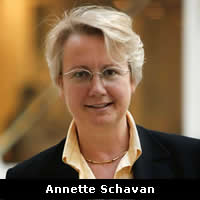
Germany's Minister for Education and Research, Annette Schavan, has promised to push ahead with the creation of a European Higher Education Area and a European Qualifications Framework while her country holds the EU's Council Presidency. Ms Schavan was speaking in the European Parliament on 30 January, presenting Germany's priorities in education for the next six months to the Committee on Culture and Education. A new programme for lifelong learning came into force on 1 January 2007. Ms Schavan welcomed the new, integrated programme, but stressed that more must be done if Europe is to meet its goal of becoming the most competitive, knowledge-based economy in the world by 2010. The minister called for a modernisation of higher education in Europe. 'Only then will universities be able to contribute their share to European innovation efforts. Our universities have enormous potential,' said Ms Schavan. Modernisation, in Ms Schavan's eyes, means not only changes to the way in which universities are monitored and managed, but also to the way in which they are financed and governed. Encouraging Member States to promote top-class teaching and research, support closer relations between universities and industry and speed up innovation and modernisation in higher education will be a focus of work done under the German Presidency, said Ms Schavan. A conference in London in May will address the steps that still need to be taken in order to establish a European Higher Education Area. The steps include greater autonomy for universities and changes to financing schemes. Germany will also be pushing forward the European Qualifications Framework. The initiative is intended to promote trans-border mobility and transparency, and to offer a translation tool enabling the classification and comparison of qualifications. 'The aim is to ensure that the European Qualifications Framework covers the full range of education and training, from formal to non-formal learning, from training qualifications to doctoral degrees and vocational skills,' said Ms Schavan. The European Commission adopted a proposal for a European Qualifications Framework in September 2006 that was regarded favourably by the Council in November. 'We are now eager to know the Parliament's views,' the minister told MEPs. 'The development of the European Union will mainly depend on how we address the issues of education and research, innovation and technology. They are the sources of future prosperity,' said Ms Schavan. She voiced optimism at how far the EU has come over the last 50 years, and finished by saying: 'It is now up to us to set Europe in motion in order to enhance growth and employment by means of education and research. The German Council Presidency will make its contribution towards achieving this goal.'
Countries
Germany