


European Council urges forward movement on JTIs, EIT and Galileo
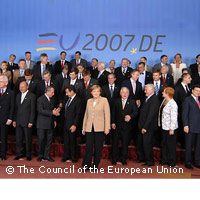
While all eyes were on treaty reform as the EU's Heads of State and Government met in Brussels on 21 and 22 June, the leaders also had other items on their agenda, including Joint Technology Initiatives (JTIs) and the European Institute of Technology (EIT). The European Council invited the Council of Ministers to agree swiftly on the first four proposals for JTIs (ARTEMIS, on embedded computer systems; IMI, on innovative medicines; Clean Sky, on aeronautics and air transport; and ENIAC, on nano-electronics technologies). The leaders also invited the Commission to present the remaining JTIs identified in the proposals for the Seventh Framework Programme (FP7) as quickly as possible, and recalled 'the importance of open and transparent management of these initiatives'. The conclusions welcome the work done thus far on the Regulation for the EIT, and call on the Competitiveness Council to agree on a 'general approach' towards the initiative during its June meeting. This approach should include provisions for adequate financing 'in accordance with Community budgetary procedures'. 'The European Council is confident that the final decision of Council and European Parliament will be taken before the end of this year,' the conclusions state. Europe's future satellite navigation system, Galileo stalled recently, after the companies involved in the public-private partnership charged with financing the initiative were unable to reach agreement on how to apportion the financial risks inherent in the project. In Brussels, the European Council reaffirmed the value of Galileo as a key project of the European Union, and asked the Competitiveness Council to take a decision on how Galileo should now be implemented in autumn 2007. The Commission has already put forward a number of suggestions on how public money could be used to finance Galileo. Current President of the European Council, German Chancellor Angela Merkel, has previously underlined the importance for competitiveness of securing the protection of intellectual property (IP). In April she spoke of a forthcoming EU charter bringing in a voluntary code of practice on IP, and promised that the German EU Council Presidency would be 'unstinting' in its efforts to push for both the implementation of the London Protocol, and then a Community patent. 'Where there's a will there's a way,' she said. The rest of Europe's Heads of State and Government are clearly behind Ms Merkel, as the conclusions from their 22 June meeting welcome the initiative for a European Charter for the use of intellectual property from public research institutions and universities. The initiative should 'improve the knowledge transfer between research and industry and its contribution to the development of the European Research Area', according to the conclusions. The Council conclusions go on to specify new amendments made to the EU Treaty drafted in 2004. Here it is specified that measures adopted under the European space policy 'may not entail harmonisation of the laws and regulations of the Member States'. Under environment, the need to combat climate change through international measures will be specified, while for energy, a reference to the spirit of solidarity between Member States will be asserted. A new point will also refer to the interconnection of energy networks.