


Council calls for swift progress to knowledge economy
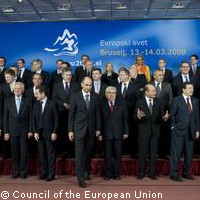
While climate change dominated talks at the Spring Summit on 13 and 14 March, EU Heads of State and Government also called for 'swift progress' to be made in implementing a strategy to unlock Europe's innovation potential. Key aspects of this strategy include meeting national research and development (R&D) investment targets, promoting large research projects such as GALILEO and the Joint Technology Initiatives (JTIs), and improving collaboration between industry and academia. Since the re-launch of the Lisbon Strategy in 2005, joint efforts have led to significant achievements in the areas of research, knowledge and innovation, such as the establishment of the European Research Council (ERC) and the launch of several JTIs. These are considered important building blocks of the knowledge-based economy that Europe hopes to become by 2010. But there is plenty more that must be done, according to the Council. At the top of the list, Member States should focus on setting out in their National Reform Programmes how progress towards national R&D investment targets will be achieved. They should also show how their R&D strategies will contribute to the realisation and better governance of the European Research Area. The Council also calls on Member States to encourage internet usage and the development of scientific e-infrastructure. With this in mind, efforts should be made to make high-speed internet available to all schools by 2010 and to set ambitious national targets for household access as part of their National Reform Programmes. On building scientific excellence, the Council underlines the importance of further promoting and implementing key initiatives, such as GALILEO and the European Institute of Innovation and Technology (EIT). It would also like to see decisions on Article 169 initiatives and additional research initiatives taken as soon as possible. In addition, 'particular attention should be given to further initiatives for joint programming of research, mutually complementary international S&T [science and technology] cooperation strategies and the strengthening of research infrastructure of pan-European interest,' reads the Council's statement. When it comes to unlocking the innovation potential and building a knowledge economy, communication between the different actors is key. In this context, the Council calls for efforts to be made to improve science-industry linkages and foster the formation of world-class innovation clusters as well as regional clusters and networks. On funding, universities should be allowed to develop partnerships with the business community so as to benefit from complementary private sector funding. Meanwhile, an EU-wide market for venture capital for the most innovative companies must be promoted. Here the European Investment Fund must play a key role in the financing of innovative small and medium-sized enterprises (SMEs). Finally, in order to become a truly modern and competitive economy, Member States and the EU must remove barriers to the free movement of knowledge by creating a fifth freedom. This would involve enhancing the cross-border mobility of researchers, as well as students, scientists, and university teaching staff. It would also require facilitating and promoting the optimal use of intellectual property created in public research organisations and encouraging open access to knowledge. Launching a new generation of world-class research facilities and promoting the mutual recognition of qualifications would also ensure greater movement of knowledge. On climate change, European leaders pledged to find an agreement before the end of 2008 on a set of measures to cut greenhouse gas emissions by 20% by 2020. These could be adopted at the latest in early 2009.