


EUREKA strengthens ties with EU
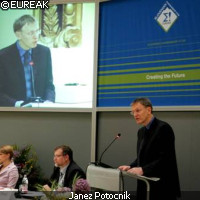
As Slovenia prepares to hand over the chair of EUREKA to Portugal on 1 July, it can do so with the confidence that it will be leaving a lasting legacy. A notable achievement has been the further strengthening of cooperation ties between EUREKA and the EU, through initiatives such as the Eurostars programme and the Joint Technology Initiatives. Established in 1985, EUREKA is an intergovernmental network dedicated to increasing industry-led research across European borders. In the space of 23 years, the network has built up a proven track record in helping industry, particularly small and medium sized companies (SMEs), to bring research results to the market quickly. However, recently 'EUREKA had begun to run out of steam,' explains Ales Mihelic, General Director Science and Technology at the Slovenian Ministry of Higher Education, and Chairman of the EUREKA High-Level Group under the EUREKA Slovenian Chairmanship. 'As Slovenian High Level Representation for nearly a decade [...] I had been involved at all levels and saw a clear need for the network to be more proactive,' he added. One of the first priorities therefore of the Slovenian Chair was to establish a new strategy for the network. In addition to raising EUREKA's visibility and expanding its membership, the new strategy also sought to increase synergies between the activities of the network and the EU. One notable achievement of the Slovenian Chair in this regard has been the successful launch of the Eurostars programme, a six-year joint initiative of EUREKA and the EU dedicated to high-risk SME research and development. The EU is supporting the initiative with a €100 million grant from the Seventh Framework Programme (FP7), while an additional €300 million will come from the 27 countries which have signed up to the initiative. This will in turn mobilise an equivalent amount in private funding, resulting in a total budget of €800 million. 'Each of us [EU and EUREKA] has advantages and strengths, the best are probably combined in this Eurostars programme,' European Commissioner for Research, Janez Potocnik told CORDIS News. Being closer to the market and flexible are well known strengths of EUREKA; these are combined with the EU's guarantee of funding and effective selection and evaluation process, he explained. 'It doesn't matter if activities are intergovernmental or Community, it's important to bring these strengthens together.' The programme will help to avoid duplication, which is a stated goal off the European Research Area, added the Commissioner. Although approval for the Community's funding contribution is still needed from the European Council, work is already underway at the EUREKA Secretariat to select the first batch of an estimated 133 projects for funding. This process is expected to be completed by the end of the summer, Luuk Borg, Head of the EURKEA Secretariat told CORDIS News. The Slovenian Chair also sought to improve communication between EUREKA's large long-term initiatives known as Clusters on their involvement in the EU's Joint Technology Initiatives (JTIs), so as to pave the way for further synergies between the two sets of initiatives. 'EUREKA has been involved in the JTIs since the very beginning,' explains Rudolf Haggenmüller, Chairman of the ITEA (Information Technology for European Advancement) Cluster. For instance, ARTEMIS embedded computing systems involves EUREKA Cluster ITEA 2, while MEDEA+, EUREKA's biggest Cluster, is also heavily involved in the ENIAC JTI on nanoelectronics. The network's industry members contributed to the strategic research agendas of these JTIs when they were still only European Technology Platforms (ETP), and now many of the board members of the Clusters are also board members in the JTIs, noted Mr Haggenmüller. 'Slovenia succeeded in improving the communication between the five EUREKA Clusters,' Mr Haggenmüller told CORDIS News. It established a structure in which the board members from the five Clusters could meet and share experiences. 'This had never been done before,' he added. Mr Haggenmüller believes this new forum for dialogue will help Clusters interested in participating in JTIs, like the telecommunications Cluster CELTIC, to learn from the successes and mistakes of those Clusters already involved. Speaking at the closing of the XXIII Session of the EUREKA Ministerial Conference. Ljubljana, on 6 June, José Mariano Gago, Minister of Science, Technology and Higher Education in Portugal, thanked the Slovenian Chair for the important initiatives it had taken. The Portuguese Chair will promote a policy of continuity, he said. The focus will be on increased international cooperation, better coordination with other intra-European R&D mechanisms and raising EUREKA's visibility.