



The toolbox improving climate resilience across EU coastal regions

Climate change is driving rising sea levels and water temperatures, increasing storm surges and threats to marine ecosystems across Europe’s coastal regions. These impacts are felt most by the coastal communities, accounting for around 40 % of the continent’s population(opens in new window). “With potentially devastating knock-on effects for livelihoods, food security and safety, coastal restoration, alongside adaption and resilience efforts, must become a priority,” says Ida Beathe Øverjordet, coordinator of the CLIMAREST(opens in new window) project. Identifying vulnerable and ecologically important habitat types, the EU-funded project implemented restoration tools, protocols and monitoring methods at five demonstration sites, from Svalbard to Madeira. “These activities have already translated into tangible benefits for citizens, from safer and cleaner coasts, to boosting local involvement in climate resilient decision making,” notes Øverjordet.
Operating across a wide latitudinal and ecological range
CLIMAREST combined technological, ecological, social and economic approaches to overcome challenges of data scarcity, low public awareness and limited uptake of restoration methods. The central objective was to develop a modular toolbox to bridge the gap between research and practice. Co-designed with the marine restoration community and co-developed with project partners, the resulting toolbox comprises two components: a website(opens in new window) hosted by the Society for Ecological Restoration(opens in new window) and a Virtual Research Environment(opens in new window) (VRE) hosted by Blue-Cloud. The website contains case studies (including from CLIMAREST), general information on marine restoration, information on running cost-benefit analyses, stakeholder engagement best practices and ocean literacy resources. The VRE lets users adapt code to run their own analyses(opens in new window), alongside web applications to visualise both field and open access data (e.g. from Copernicus(opens in new window) and EMODnet)(opens in new window). There are also tools for developing marine restoration protocols, alongside demonstrations of code-based tools such as AI image detection.
Arctic-to-Atlantic demonstrations
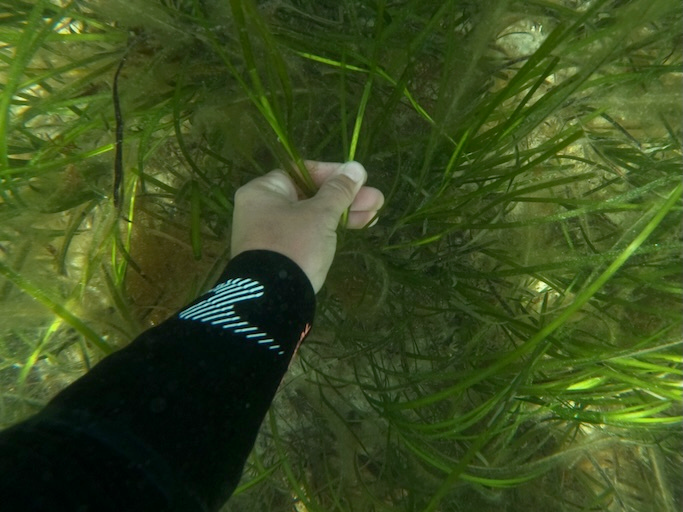
CLIMAREST tested diverse Arctic to Atlantic restoration solutions, tailored to local ecological challenges, climatic conditions and socio economic contexts. The range included: coastal erosion and wastewater impacts (Svalbard, Norway), seagrass meadow restoration (Ireland and Andalusia, Spain), native oyster reef restoration (Bay of Quiberon, France), soft bottom ecosystems and aquaculture impacts (Vigo, Spain) and rocky bottom ecosystems and brown algae restoration (Madeira, Portugal). In Svalbard for example, nature based coastal protection structures were installed to counteract erosion driven by permafrost thawing, complemented by impact assessments of wastewater on fjord ecosystems. While in the Bay of Quiberon, CLIMAREST undertook one of the largest reef restoration efforts in Europe, deploying hectare sized substrates to restore native flat oysters, with the help of shellfish farmers. “While the range of challenges taught us there was no ‘one-size-fits-all’ answer, one constant was community engagement. From Arctic tourism operators, to dive centres, local involvement consistently improved outcomes. New monitoring tools are also game changers: eDNA, remote sensing and AI-based image analysis, helped us to compare sites and detect early signs of success or failure,” explains Øverjordet.
Scaling up is achievable, with careful planning
Through the restoration of marine ecosystems, reduced pollution and supporting a blue economy with evidence on carbon capturing habitats, CLIMAREST contributes directly to EU priorities including Mission Ocean(opens in new window), Mission Adaptation to Climate Change(opens in new window) and the EU biodiversity strategy(opens in new window). Alongside its open access protocols, the team have developed replication roadmaps, complemented by financial(opens in new window) and technical planning tools(opens in new window), enabling others to adopt its approaches. “Our roadmap showed that large-scale, multi-habitat restoration is achievable once ecological baselines, governance and technical capacity are established,” adds Øverjordet. To help facilitate this, the team is capitalising on the project’s results by maintaining the demonstration sites for ongoing monitoring, innovation and stakeholder engagement.