New antenna for mega satellite communication constellations

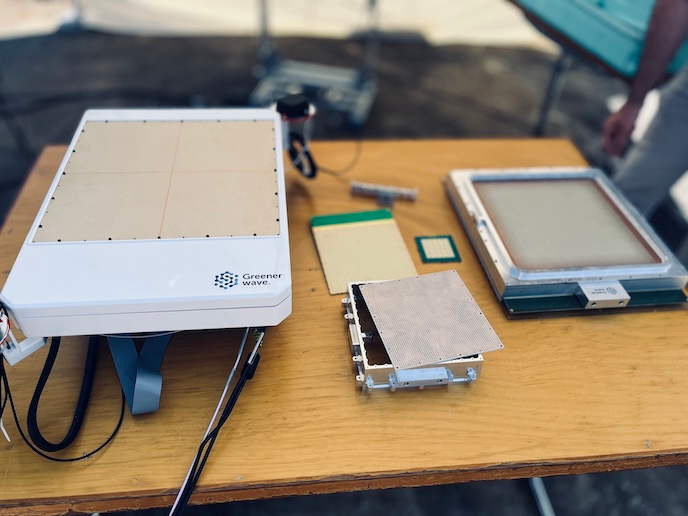
We may live in a highly connected world, but more often than not, that connectivity starts in space. “Driven by the rapid emergence of low Earth orbit – LEO – satellite constellations, the satellite communication market is growing – and growing fast,” says Adrien Thiriet, SatCom programme manager at Greenerwave(opens in new window). With the support of EU funding from the European Innovation Council(opens in new window), Greenerwave has developed a flat-panel electronically steerable Ka-band antenna. Ka band is the electromagnetic spectrum ranging from roughly 17 to 31 GHz that is used for high-capacity, high-speed satellite communications. “Ka band is the future of communications, and by unlocking at least a fivefold reduction in production costs and energy consumption, our innovative antenna solution paves the way for the widespread deployment of LEO satellites and the creation of mega constellations,” adds Thiriet.
A European Ka-band satellite communication terminal
With the goal of developing a truly European Ka-band satellite communication terminal, Greenerwave leveraged its existing reconfigurable intelligent surface (RIS). RIS is a technology composed of unit cells that can be controlled dynamically to ‘tune’ satellite signals using reflection and smart AI algorithms. According to Thiriet, the first step was to design an RIS capable of operating across the entire Ka band. Once this was complete, the company could develop a Ka-band beamformer, the core part of an end-user electronically steerable antenna that is used to achieve directional transmission and reception. From here, the team was able to evolve the beamformer into a fully functional terminal ready to establish communications when the satellite is either paused or on the move. “The net result of this work is the world’s first single-aperture, full duplex Ka-band SatCom electronically steerable antenna – an important achievement that was made possible thanks to the EU funding we received,” explains Thiriet.
Advancing European sovereignty in space
In addition to its significant technology achievements, Greenerwave’s work helps advance European sovereignty in space. “Satellite communications is a critical infrastructure and one that Europe simply cannot afford to outsource to or rely on other countries and companies,” notes Thiriet. Knowing this, Europe is currently building IRIS2(opens in new window), a multi-orbital satellite constellation that will provide secure connectivity services to the EU and its Member States, as well as broadband connectivity for governmental authorities, private companies and European citizens. Invented in France, the Greenerwave Ka antenna is compatible with the IRIS2 spectrum and will be ready to provide the constellation with a low-cost antenna that requires fewer semiconductors and extremely low power consumption and heat dissipation. As the company prepares for the deployment of IRIS2 and other Ka-band LEO constellations, the team continues to improve its technology and its performance. It is also in discussions with several potential commercial partners. “When the market reaches full maturity, Greenerwave will be ready,” says Thiriet.