Powering Europe’s ports with hydrogen

Port terminal operators face increasing pressure to meet ambitious climate targets. Investing in innovative technologies to achieve this however can be risky due to uncertainties around performance, safety and return on investment. Demonstration projects can play a critical role here, enabling the testing of innovative technologies before commercialisation. The EU-funded H2Ports(opens in new window) project for example identified hydrogen as a promising low-carbon fuel alternative for various port terminal operations.
Low-carbon alternative for port operations
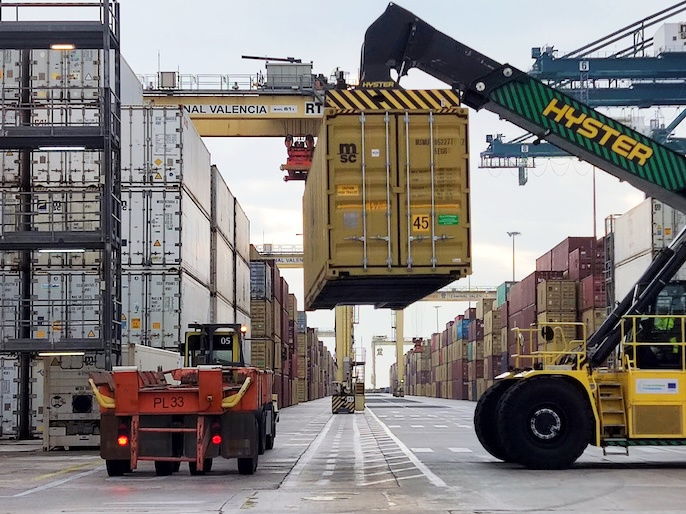
“H2Ports proposed three complementary pilots(opens in new window) to demonstrate how hydrogen can be used across different port terminal activities,” explains H2Ports project member Jorge Miguel Lara López, senior project manager at the Valenciaport Foundation(opens in new window) in Spain. “In the first pilot, we wanted to deploy a mobile hydrogen refuelling station to provide a reliable supply of green hydrogen to two different port terminals.” The second pilot set out to introduce the world’s first hydrogen fuel‑cell-powered Reach Stacker, a specialised port machine used to move containers. The objective was to prove that hydrogen can meet the high power and availability requirements of container handling operations. The third pilot meanwhile set out to demonstrate the world’s first retrofitted 4x4 hydrogen yard tractor, a vehicle designed to move cargo on and off vessels. “Together, these pilots offer a credible, low‑risk hydrogen alternative for diverse port operations,” says Lara.
Reliability, refuelling procedures and energy efficiency
These three innovations were tested under real operating conditions within active terminals at the Port of Valencia. Hydrogen‑powered equipment was integrated into day‑to‑day terminal operations, allowing performance, reliability, refuelling procedures and energy efficiency to be closely monitored. “This real‑world deployment required the formalisation of hydrogen use for port machinery, including the definition of operational protocols, safety procedures, contingency and emergency plans, and dedicated training programmes for port workers and stevedores,” adds Lara. A key lesson from the pilots was the importance of early and continuous cooperation between all actors involved, including port authorities, terminal operators and technology providers. This coordinated approach proved essential to successfully integrating hydrogen into complex port environments. “The project also highlighted that the design of hydrogen logistics, from production to storage and refuelling, is critical to ensuring reliability and reducing overall costs,” notes Lara. “By optimising supply chains and on‑site infrastructure, hydrogen can become a more economically attractive solution for terminals.”
Transition towards more sustainable operations
As first‑of‑a‑kind prototypes, the next steps focus on improving the hydrogen‑powered machines in terms of maturity, robustness and operational efficiency. In parallel, detailed cost–benefit analyses are needed to support terminal concessionaires, who make the investment decisions, in assessing hydrogen as a viable alternative. “Achieving more competitive hydrogen prices through optimised supply and logistics is critical to compete with electric and diesel options,” remarks Lara. “In this context, testing additional types of hydrogen‑powered port machinery would help create a broader hydrogen ecosystem within ports, increasing demand, reducing costs and strengthening the business case for large‑scale deployment.” By operating hydrogen‑powered equipment in active terminals, the project has helped ports and terminal operators progress from studies to practical decarbonisation alternatives. “H2Ports expands the portfolio of available zero‑emission solutions for ports, reducing uncertainty and enabling informed decision‑making,” says Lara. “Ultimately, the project contributes to accelerating the adoption of viable decarbonisation pathways and supporting ports in their transition towards more sustainable operations.”