



Arctic transport infrastructures shape regional development

The Arctic is transforming into a hotspot of economic and geopolitical interest, as this remote and scarcely populated region has become a site of renewed development ambitions(opens in new window). “Many of these activities necessitate the construction or upgrading of transport infrastructure. While typically undertaken by external actors and interests, these have profound impacts on local livelihoods and communities,” says Peter Schweitzer, principal investigator in the INFRANORTH(opens in new window) project, which was funded by the European Research Council(opens in new window). INFRANORTH explored how existing and planned transport infrastructure supports local Arctic communities or attracts temporary residents such as tourists and military personnel, “capturing both intended and unintended consequences,” adds Schweitzer from the University of Vienna, the project host.
A pan-Arctic comparison of local transport affordances
INFRANORTH adopted a ‘relational affordance’ perspective, focused more on the material, affective and ideological relations between objects (transport infrastructures) and permanent Arctic residents, than on the goals of investors, politicians or engineers. Following Russia’s 2022 full-scale invasion of Ukraine, INFRANORTH’s comparative research focused its fieldwork on European and North American Arctic sites, while the Russian Arctic component relied on pre-existing field data and the neighbouring coastal communities of Nome (United States) and Kirkenes (Norway). Mapping (cartography and GIS methods for spatial analysis and visualisation), future scenario workshops and archive research was combined with ethnographic fieldwork, including interviews and participant observation. Quantitative population data, alongside a survey on transport infrastructure with local communities, introduced the regional and pan-Arctic level. “The quantitative population data related local field findings to wider phenomena and trends, for a more comprehensive analysis that was both micro and macro,” explains Schweitzer. Crucially, the project developed a methodological framework, sharing and standardising protocols, to enable meaningful comparisons.
The influence of economic and geopolitical interests
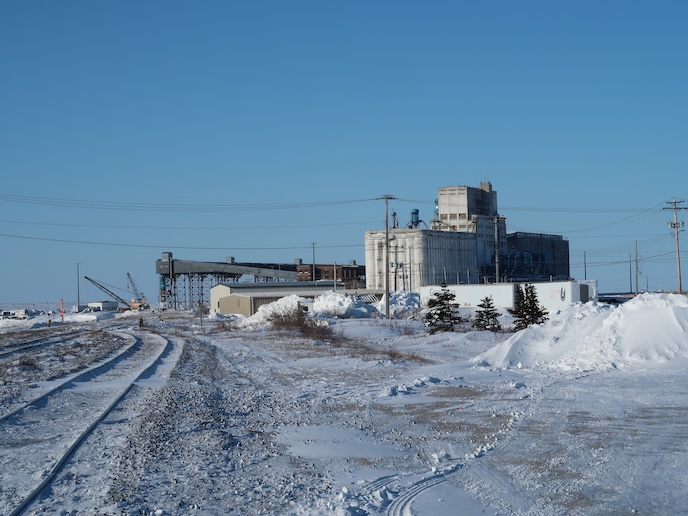
With small populations, combined with environmental challenges and building costs, necessitating outside investment, INFRANORTH reconfirmed that Arctic transport infrastructures expose most communities to similar challenges. “As transporting people and goods is economically unviable, the driver typically becomes resource extraction, or geostrategic considerations,” notes Schweitzer. A key finding was that Arctic transport infrastructures have very different local affordances, with one prominent determinant being the amount of local and regional control over construction and use. “This refers to issues of governance, alongside levels of devolution and democracy. For example, in northern Manitoba, Canada, since 2018 a consortium of Indigenous and local communities took over the Hudson Bay Railway from an international company, resulting in improved services,” remarks Schweitzer. Additionally, the research found that while certain kinds of transport infrastructure – for example, airports – are vital for Arctic residents, others – such as large seaports – offer more limited benefits. “Tourism, the biggest driver of Arctic traffic in some areas, often strains infrastructure capacity, as does resource extraction to meet demand for critical minerals, accompanied by a growing military presence,” says Schweitzer.
A more sustainable and inclusive Arctic transport infrastructure
Last year INFRANORTH held an ‘Arctic Transportation Futures: Reconciling Local Needs and Global Drivers’(opens in new window) workshop with government, regional planning authorities, private-sector and research institution representatives, also involving Indigenous voices. Policy recommendations included prioritising local communities, notably: co-creation with local stakeholders; greater transparency and accountability throughout development processes; and monitoring post-construction impacts while addressing unintended consequences. “This is an exemplary field for transdisciplinary knowledge co-creation, underpinned by scientific and social insights,” adds Schweitzer intending to explore how communities engage with transport infrastructures in other remote regions, such as the European Alps. Meanwhile, the team continues to publish project results, with a book already in preparation.