Venice at a crossroads: why no adaptation strategy can save the city as we know it

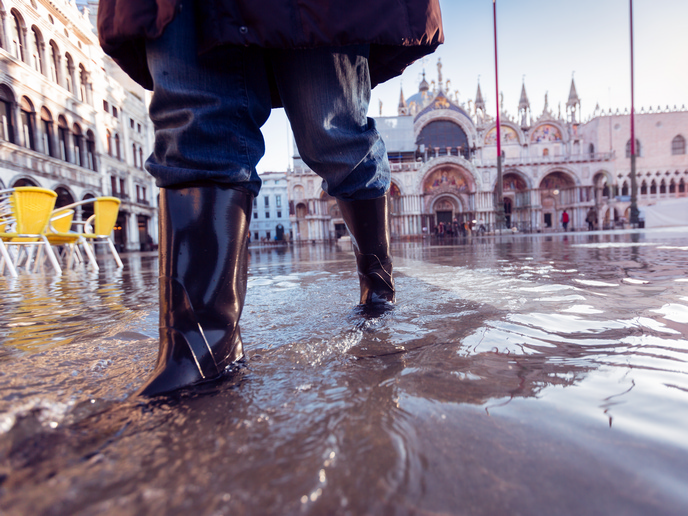
Venice has coexisted with the sea for 1 500 years, but accelerating sea level rise and land subsidence now threaten its very existence. A new study(opens in new window) supported by the EU-funded P2R(opens in new window) and CoCliCo(opens in new window) projects analyses different long-term adaptations for Venice and its lagoon. Published in ‘Scientific Reports’, the findings are stark: no strategy can preserve the city as it is now indefinitely. Instead, adaptation requires accepting fundamental transformation.
The limits of current defences
Venice’s current defences, the MOSE barriers, consist of 78 huge steel gates attached to the seafloor to prevent excessively high tides from entering the lagoon. These mobile barriers cost EUR 6 billion and became operational in 2020. While effective against occasional high waters, they are now being used more and more frequently. Between 2020 and 2025, the barriers closed 108 times; but in just the first two months of 2026, they have already been activated 30 times. As sea levels rise, the MOSE system risks becoming a semi-permanent seal rather than an occasional shield. Frequent closures would severely disrupt shipping and tourism, alter lagoon ecology, and necessitate massive new infrastructure for sewage treatment and water pumping. Even with supplementary measures such as injecting sea water into the rocks deep underground to reverse subsidence, MOSE’s effectiveness diminishes beyond approximately 1 metre of sea level rise.
Alternatives and trade-offs
The study evaluates progressively radical alternatives. Building a ring of dykes around Venice itself could physically separate the city from the lagoon, potentially becoming necessary by 2100. Estimated costs range between EUR 500 million and EUR 4.5 billion. A more extreme option involves enclosing the entire lagoon within a ‘super levee’ system supported by continuous pumping, capable of withstanding up to 10 metres of sea level rise. However, this approach, costing over EUR 30 billion, would severely compromise the lagoon’s living ecosystem. Beyond 5 metres of sea level rise, projected after 2300, relocation of much of the city and population to safer ground may become the only viable option, with costs reaching up to EUR 100 billion. However, as study co-authors Robert James Nicholls, Marjolijn Haasnoot and Piero Lionello comment in an article(opens in new window) published in ‘The Conversation’, costs are not the only concern. “How do you even put a price on the cultural value of Venice?” they ask. “Especially as none of these measures will be able to sustain the Venice we see today in the long-term. Adaptation can manage change up to a certain point – beyond that, we are no longer preserving the present. Rather, we are designing a fundamentally different future.” Critically, the research shows there is no optimal strategy. Each pathway involves trade-offs between residents’ well-being and safety, economic prosperity, the future of the lagoon’s ecosystems, heritage preservation, and the region’s traditions and culture. Unlike many vulnerable coastal areas that continue attracting development, Venice is engaging in essential long-term planning. However, implementing major interventions such as the ones outlined above can take decades. The implications of the study supported by P2R (Pathways2Resilience: Co-developing pathways towards Climate resilient regions in Europe) and CoCliCo (COASTAL CLIMATE CORE SERVICES) extend beyond Venice. All low-lying coastal regions must recognise the inevitability of long-term sea level rise and begin preparing now. For more information, please see: P2R project website(opens in new window) CoCliCo project website(opens in new window)