Tapping Europe’s urban mine

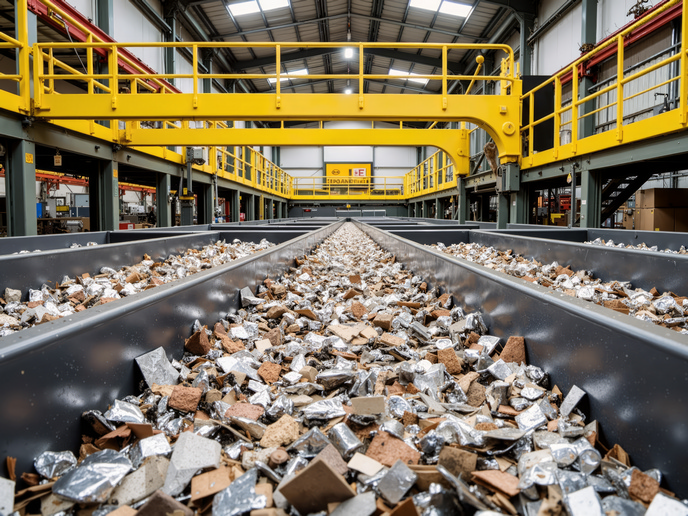
The demand for critical raw materials (CRMs) is projected to significantly increase in the coming decades. “While these materials are crucial to Europe’s green and digital transition, as well as its economic independence, the majority of its supply is controlled by a small number of non-EU countries – making Europe particularly vulnerable to geopolitical tensions,” says James Horne(opens in new window), project manager at the Waste of Electrical and Electronic Equipment Forum(opens in new window) (WEEE Forum). Although Europe lacks primary domestic sources of CRMs, it does have a potentially lucrative secondary source: everyday waste. Helping to tap into this ‘urban mine’ is the EU-funded FutuRaM(opens in new window) project. “FutuRaM provides insight into the potential for extracting critical raw materials from the waste generated in Europe, giving the EU an opportunity to source some of its CRM supply internally and reducing its reliance on primary sources elsewhere in the world,” adds Horne, who coordinates the project.
Forecasting critical raw material quantities
With a focus on batteries, electrical and electronic equipment, vehicles, mining, slags and ashes, and construction and demolition waste, the project employed an innovative method for evaluating a waste stream’s CRM potential. The method assesses secondary and CRMs data to model their current stocks and flows. It also integrates detailed future scenarios to estimate the quantity of raw material within each waste stream through to 2050. “The aim is to support the commercial exploitation of both secondary raw materials and critical raw materials by manufacturers, recyclers and investors, and to support policymakers and governmental authorities,” explains Horne. Data and projections for all waste streams can be explored via the project’s Urban Mine Platform(opens in new window).
Supporting the Critical Raw Materials Act
The project’s research also focused on the development of the United Nations Framework Classification for Resources (UNFC) – a tool that enables a better understanding of the viability of raw material projects. “The adaptation of the UNFC methodology provides a harmonised and holistic framework to assess and transparently communicate the feasibility of recovery projects to project developers, authorities and policymakers,” notes Horne. As part of the project’s work, the UNFC’s assessment criteria were modified and tested to better capture the specific characteristics of secondary resource projects, resulting in a more comprehensive evaluation of their technical, socio-economic and environmental viability. The project’s results also helped implement the EU’s Critical Raw Materials Act(opens in new window). “https://commission.europa.eu/about/departments-and-executive-agencies/internal-market-industry-entrepreneurship-and-smes_en (DG GROW) asked our researchers to provide data to help identify hot spots of critical raw materials in the waste stream so these could be targeted,” remarks Horne. “It was great to be able to deliver this during the project, as it’s not often that a project’s results are used before it even concluded.” The UNFC methodology can be utilised via SARA4UNFC(opens in new window), an online tool developed by FutuRaM.
A data mine on waste streams
The FutuRaM project has delivered an informative data mine on several waste streams, each of which is key to bolstering Europe’s CRM supply. “This, coupled with the development of the UNFC method, provide a strong basis for a more efficient implementation of new secondary raw material processes in Europe,” concludes Horne. The project team plans to expand on its work via FutuRaM 2, an EU-funded project set to commence in early 2027.