


European instruments on first Indian lunar expedition
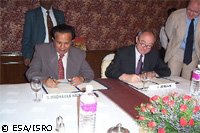
The European Space Agency (ESA) and the Indian Space Research Organisation (ISRO) signed an agreement on 27 June on including European instruments on board India's first scientific mission to the Moon, Chandrayaan-1. Chandrayaan-1 is planned for launch around 2007 on board India's Polar Satellite Launch Vehicle. The 525 kg satellite will be placed in 100 km polar orbit around the Moon and will have a lifetime of two years. It will help to unravel the mysteries of the origin and evolution of the Solar System and, in particular, the Moon. This agreement, under the umbrella agreement for cooperation already existing between ISRO and ESA, was signed by Mr G Madhavan Nair, Chairman of ISRO, and Mr Jean Jacques Dordain, Director General of ESA, at Bangalore. The Indian Space Research Organisation (ISRO), founded in 1969, launched its first satellite in 1975. Since then it has developed a number of launch vehicles as well as satellites for Earth observation, remote sensing, telecommunications and weather forecasting. Chandrayaan-1 marks its first venture into planetary space science. Under the agreement, Europe will potentially co-ordinate and support the provision of three instruments. A low energy (0.5-10 keV) X-ray spectrometer called Chandrayaan Imaging X-Ray Spectrometer, from Rutherford Appleton Laboratory, UK, will measure elemental abundance distributed over the lunar surface using X-ray fluorescence technique. It will also include an X-ray solar monitor to record the incident solar X-ray flux. Near Infra-Red (IR) Spectrometer from Max Planck Institute for Aeronomy, currently Max Planck Institute for Solar System Research, Germany, will detect and measure lunar mineral abundances. SARA, a sub keV Atom Reflecting Analyser from the Swedish Institute of Space Physics, developed in collaboration with India, will measure volatiles generated due to solar wind impacting on the lunar surface and determine the surface magnetic field anomalies. The instruments requested are identical to those on ESA's SMART-1. Launched in 2003 and having demonstrated a new solar-electric propulsion system and tested other technologies on its way to the Moon, SMART-1 has just started its science phase. It will compile the first comprehensive inventory of key chemical elements in the lunar surface. Direct ESA in-kind contributions are also foreseen under this historical agreement. ESA and ISRO will share the data resulting from their respective experiments.
Countries
India