


Ariane 5 rocket launches Japanese and French satellites into orbit
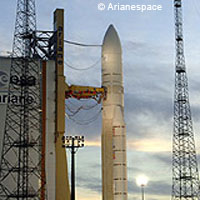
On 11 August, Ariane 5 ECA completed another ascent into space, successfully launching two telecommunications satellites into geostationary transfer orbits. The Ariane 5 ECA is the latest version of the Ariane 5 launcher. Unlike its predecessors, it is designed to handle dual launches of very large satellites weighing up to 9.6 tonnes. The increased performance of the Ariane 5 ECA is due to a more powerful Vulcain-2 first stage engine and a cryogenic upper stage (ESCA). After an on-time morning lift-off from Europe's Spaceport in French Guiana, the heavy-lift launcher released Japan's JCSAT-10 satellite which will provide fixed satellite services (FSS) for Japan, the Asia-Pacific region and Hawaii. It carries a mixed relay payload of 30 Ku-band transponders and 12 C-band transponders. Five minutes later, the rocket delivered the Syracuse 3B, a military communications satellite for France's Defence Ministry. Syracuse 3B will operate nine super high frequency (SHF) and six extremely high frequency (EHF) secure relay channels. Its mission will be to upgrade existing relay links between French political and military authorities and operating units deployed worldwide. The launch marks Ariane 5's 28th mission, and its 14th consecutive successful launch. 'Tonight's success is particularly exemplary, and perfectly illustrates why we have launched a total of 237 satellites during the past 26 years - which, by far, is a world record,' said Arianespace Chief Executive Officer Jean-Yves Le Gall. Mr Le Gall announced that next Ariane 5 launch will take place in mid-September and will carry the DIRECTV 9S television broadcast satellite for the US digital TV group, DIRECTV, along with the Optus D1 telecommunications spacecraft for the Australian company, Optus. An auxiliary payload will also be carried on the flight: the LDREX-2 deployable antenna demonstrator from the Japan Aerospace Exploration Agency (JAXA).