


Third 2007 Nobel Prize awarded to European scientist
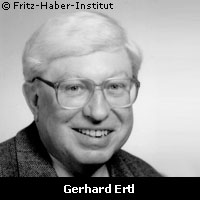
After European scientists had already won in two categories of this year's Nobel Prize awards comes the announcement that the 2007 Nobel Prize in Chemistry is also coming to Europe: Max Planck Society researcher Gerhard Ertl was chosen by the Royal Swedish Academy of Sciences 'for groundbreaking studies in surface chemistry'. In the 1960s, when surface chemistry was still in its infancy, Gerhard Ertl was one of the first to see the potential of the new techniques emerging from processes developed in the semiconductor industry, the Nobel committee explained in its citation. 'Step by step, he has created a methodology for surface chemistry by demonstrating how different experimental procedures can be used to provide a complete picture of the surface reaction.' Surface chemistry studies forces and processes that act on the surfaces of fluids and solids. The surface medium - iron, for instance - absorbs the reactants in a process and then acts as a catalyst for the reaction. Surface chemistry 'can help us to understand such varied processes as why iron rusts, how fuel cells function and how catalysts in our cars work', the committee said. Fields of application lie mainly in industrial operations, such as the production of artificial fertilisers, and in the semiconductor industry. But surface chemistry can even shed light on the destruction of the ozone layer. In order to study how individual layers of atoms and molecules behave on the extremely pure surface of metal, for example, avoiding contamination of the test set-up is essential. As a result, surface chemistry requires great precision and a variety of experimental techniques. 'Gerhard Ertl has founded an experimental school of thought by showing how reliable results can be attained in this difficult area of research,' the jury pointed out. 'His insights have provided the scientific basis of modern surface chemistry.' Professor Ertl, who also celebrated his 71st birthday on 10 October 2007, said that although he knew that he was one of the nominees, winning the award had taken his breath away. 'At least the Nobel committee granted me 20 minutes to collect my thoughts and prepare for the onslaught of the press,' he said. Unlike his colleagues, Professor Ertl will not have to share his 10 million Swedish Kronor (about €1.1 million) prize money. Gerhard Ertl was born in 1936 in Bad Cannstadt, close to the German city of Stuttgart. He received his PhD in physical chemistry in 1965 from the Technical University of Munich. After pursuing his career at various universities and institutes in Germany and the US, he joined the Fritz Haber Institute of the Max Planck Society in Berlin in 1986. There, he occupied the post of director of the Department of Physical Chemistry until 2004 and currently holds the position of Professor Emeritus.