How Indigenous societies went from ‘vanishing people’ to global players

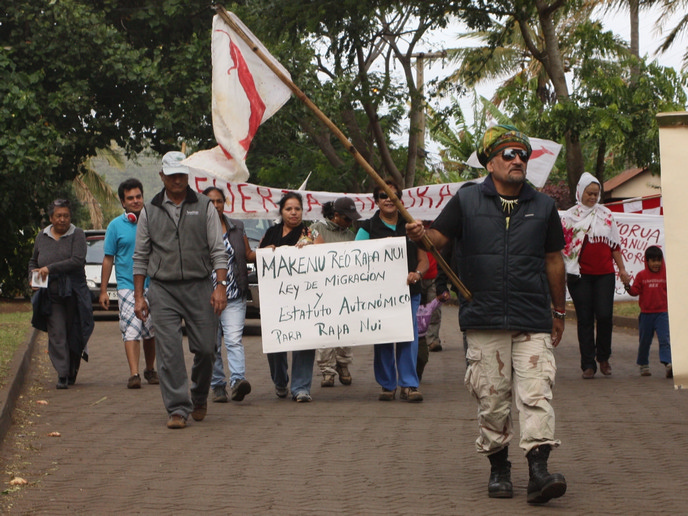
Indigenous peoples have a long history of being misunderstood. Through much of the 20th century, many anthropologists thought Indigenous societies were vanishing – an incorrect assumption borne out of an outdated, colonial world view. “Missionisation, colonialism, science and capitalism, who have worked together over centuries on a global scale, have been built, in many ways, on the assumption that so-called inferior societies need to assimilate to dominant forces to be able to survive,” explains Philipp Schorch, professor of Museum Anthropology at Ludwig Maximilian University of Munich. However, nearly two decades on from the adoption of the United Nations Declaration on the Rights of Indigenous Peoples, Indigenous representatives are now present at major global initiatives, including the United Nations Framework Convention on Climate Change and the Humboldt Forum in Berlin. Indigenous knowledge is also being increasingly drawn on in the scientific world, to help tackle global challenges. In the IndiGen(opens in new window) project, which was funded by the European Research Council(opens in new window), researchers explored the journey of Indigenous peoples from being seen as declining societies to major players on the world stage. Through multidisciplinary analysis spanning multiple fields, the project sought to untangle the various international links that shaped this view and explore how it may be redefined for the future. “Many Indigenous people have always managed to adopt and adapt, but without losing their identities and sense of self,” says Schorch. “In our project, we have allowed for such Indigenous stories of resilience, flexibility and creativity to be told. At a time when alternative ways of knowing and being are needed, such stories are globally relevant,” he adds.
Exploring the so-called Indigenous renaissance
The IndiGen project sought to include global knowledge and local experience in a common framework, to identify the historic moments and processes which have shaped anthropological and other scholarly discourses. This included a collaborative study on the ways Indigenous people adopt external views about themselves. It also explored, through research, films and exhibitions, elements of continuity and change underlying Indigenous presences. “Our project has been profoundly collaborative, involving Indigenous and non-Indigenous artists, curators, filmmakers and scholars from across the Americas, the Pacific and Europe to both study and articulate what being Indigenous in the 21st century means,” explains Schorch. “In doing so, we have crossed the disciplinary fields of art, film, history, anthropology and museology.”
Documenting a radical shift of knowledge
Schorch notes that the collaborative work across multiple locations was key to the success of the project, which even continued during the COVID-19 pandemic. “The way we have worked, and the cross-cultural knowledge we have produced, is shown in our publications, films and exhibitions,” he adds. By producing work in so many mediums, the project was able to reach a much wider public audience than pure academic study, says Schorch, though he highlights the importance of this too in shifting the overall narrative. “Enabling Indigenous perspectives to intervene in European contexts has entailed a radical shift of knowledge, compared to the initial contexts of missionisation, colonialism, science and capitalism, which entangled different worlds centuries ago,” he remarks.
Continued circulation of Indigenous stories
The researchers expect the outcomes of their work, including publications, films and exhibition catalogues, will all continue to travel and circulate around the world through open access. Several key publications will come out this year and next year, while Schorch will continue to run several related projects. “These will also generate and circulate knowledge that aims to make people rethink and redo,” he concludes. “Given the state of the world, this is much, much needed.”