


EU funded marine drilling expedition offers PROMESS of increased climate knowledge
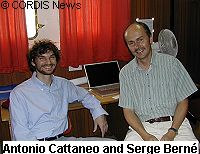
For over a decade now, scientists have been recovering deep ice core samples from polar regions in order to use them to gain a better understanding of the global climate conditions on Earth over the past million or so years. While such data have provided a valuable insight into the Earth's general climatic state throughout this period, there is little in the results that can be directly related to a particular region of the world, such as Europe. By the late 1990s, however, experts like Professor Jean-Pierre Henriet from Ghent University began to advocate the collection of core samples taken from the sedimentary deposits that collect on the sea floors around Europe's coastlines, which could be used to gain an accurate record of past climatic conditions and sea levels in Europe. The main challenge was finding a research vessel equipped to collect core samples from the continental shelf, as currently the only ship equipped for scientific drilling, the Joides Resolution run by the International Ocean Drilling Program (IODP), is equipped primarily for deep sea drilling. There is one sector, however, where such vessels are used regularly. The oil and gas industries use drilling vessels for a variety of tasks, most notably for prospecting activities and for assessing the stability of offshore platform sites. Under the energy, environment and sustainable development priority of its Fifth Framework Programme (FP5), the Commission launched an initiative to provide scientists with access to research infrastructures that could not be made available by any single institute or country, and in the case of marine research facilities this offered an opportunity for researchers to 'borrow' one of industry's drilling vessels. The PROMESS 1 initiative (profiles across Mediterranean sedimentary systems) was set up to provide a multidisciplinary team of 14 scientists with the opportunity to retrieve sediment core samples from sites of interest in the Mediterranean and Adriatic - the first time that such an expedition has been undertaken. Having spent a month working at sea, the Russian vessel 'Bavenit' arrived back at port in Barcelona on 22 July, and CORDIS News was dockside to meet the team and find out what they had managed to achieve so far. The general objectives of the voyage were threefold: to reconstruct sea level and climate changes over the past 500,000 years based on the collection and analysis of high resolution sediment cores; to study the impact of these changes on the stability of sedimentary slopes and processes such as underwater avalanches; and to increase understanding of the processes that form strata on continental margins - an area of specific interest to the oil prospecting industry. Following a call for tender process, a Russian vessel, run by the Dutch geotechnical company FUGRO, was selected for the expedition. The features that made the 85 metre long ship particularly suited for the job were its 35 metre derrick, which allows drilling apparatus to be used deep below the sea floor; a dynamic positioning system, incorporating satellite positioning and a series of engine thrusters that allow the vessel to remain exactly above the borehole; and a complex system designed to compensate for the heave and roll of the ship on the drill pipe. Before any of this equipment could be put to full use, however, the team first needed to know where to drill. Part of the responsibility for identifying the ideal locations fell to Antonio Cattaneo from the Institute for Marine Science in Bologna, Italy. Using a process called seismic reflection, Dr Cattaneo built up acoustic profiles of the various layers of sea floor sediments in areas of greatest interest to the PROMESS 1 team, and helped to define targets where the layers were thickest and thus offered the best chance for gaining accurate data. Sites in the Mediterranean were selected that could reveal climate and sea level information stretching back some 500,000 years and, in line with Dr Cattaneo's own particular area of expertise, two sites were also selected in the Adriatic, one of which was aimed at revealing the most recent sediments, covering the last 12,000 years. 'This type of sediment can give a very high resolution, and also reveals the changes in sedimentation during times of human activity, for example during early agriculture and more recently from damming,' said Dr Cattaneo. 'Of particular interest in the Adriatic are layers of volcanic ash, which give us a very good time reference and help us to control and cross reference different core samples with each other,' he added. The process of extracting the cores themselves required extreme precision, Dr Cattaneo explained. First, a bore hole is drilled to the required overall depth without the removal of a sample, in order to check for the presence of potentially dangerous underground gas reservoirs. Then, starting at the sea floor, core samples are removed roughly 80 centimetres in depth at a time. Once the sample has been retrieved, a drill is used to remove the section of sea floor that has just been cored, and the process begins again. With the vessel's skilful Russian crew controlling the process, Dr Cattaneo said that each core took as little as 20 minutes to retrieve, but given that the longest continuous sample was removed from over 300 metres under the sea floor, that still represented a laborious process. During the expedition as a whole, over 570 metres of core samples were collected. According to the project's chief scientist, Dr Serge Berné from the French research institute for the exploration of the sea (IFREMER) in Brest, France, this represented more than a 100 per cent success: 'Under the original budget, we hadn't planned to do as much as we actually did. FUGRO [the vessel's commercial operators] were very flexible and wanted the expedition to be a success, and we were able to achieve the 'ideal scenario' of samples,' he told CORDIS News. 'Although we don't have the final results yet, we are very excited about the quality of the data,' said Dr Berné, who explained that in order to carry out the types of study that they intend, it is important to have sufficient quantities of nano organisms contained within the core samples, which preliminary analysis reveals to be the case. Having transferred the refrigerated samples from the ship back to his institute in Brest, Dr Berné is now preparing to carry out a series of further investigations to uncover new knowledge in sediment preservation, sea level changes, rapid climate change and sea temperatures. 'We were able to carry out some major tasks on the ship, but now we need to carry out several months or even years worth of further research on the samples in order to fully process all the data,' said Dr Berné. Asked to comment on the importance of carrying out such an initiative at an EU level, Dr Berné said: 'This is definitely the kind of project that can only be achieved with EU support. I can't imagine a single institute or European country being able to do this on their own. This is a commercial vessel, which for a scientist is very hard to get access to.' 'One of the underlying objectives of this project was to test the feasibility of carrying out such a large scale, multidisciplinary cooperation. It wasn't just the 14 scientists on board that were hoping for a good result, the whole marine research community had a vested interest in the outcome. I hope that our success will encourage the Commission to launch similar initiatives under future framework programmes,' Dr Berné added. Indeed, Piia Tuomisto, a scientific officer from the European Commission, described the PROMESS1 expedition as a beautiful example of a European funded initiative. 'This project is based on real cooperation with industry, and by giving European scientists access to infrastructures that no single country could afford, it makes a definite contribution to building a European Research Area in marine sciences.' Ms Tuomisto also highlighted the innovative structure of the project, with a large proportion of the budget being subcontracted out to the industrial partner, and added that the results would advance basic knowledge of sediments and global change, while also possibly having commercial applications in the oil prospecting industry. As he was leaving the ship to return to his home in Brest, CORDIS News asked Dr Berné how it felt to be going ashore after a month of 12 hour working days at sea. 'I have mixed feelings to be leaving. I am certainly happy to be going home, but after such an intense month it is sad to be leaving also.' As he begins to tackle the months of laboratory work required to finish the PROMESS 1 project, though, Dr Berné hopes that his experience will be the first of many successful collaborations at sea for Europe's research community.