Do hummingbirds ever sleep?

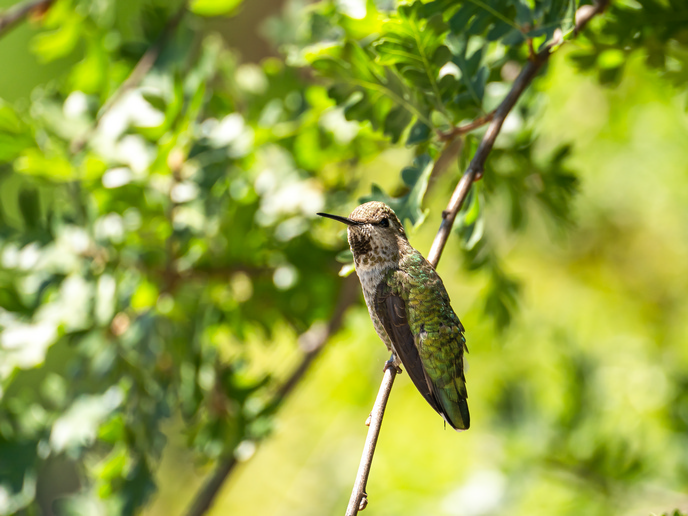
Anyone who has supervised a child’s sugar-fuelled birthday party might beg to differ, but nothing comes close to energy consumption and expenditure of a hummingbird. “These birds are absolute outliers from a physiological perspective,” says Graham, an ecologist at the Swiss Federal Institute for Forest, Snow and Landscape Research WSL(opens in new window). “They burn through huge amounts of energy – something like the equivalent of a human eating 300 hamburgers a day.”
Energy-intensive lifestyles
Such quantities of energy are necessary to find food (hummingbirds forage almost entirely on nectar, though some also eat insects). They are experts at hovering, requiring up to 1 000 heart beats per minute and an incredible 50 to 80 wing beats a second. “Their unique wing joints enable them to flap in this figure of eight pattern which makes them the masters of hovering,” adds Graham. This enables them to access high-energy nectar from flowers extremely efficiently. A hummingbird’s typical day is therefore spent on a constant quest for food. After two or three hours without nutrition, some species will even die.
The benefits of sleep
All this sounds exhausting. The good news is that hummingbirds also know how to take it easy. At night they can turn off various body processes, cooling off, and bring their heartrate down to around 50 beats per minute. This state of deep torpor, as it is called, enables them to conserve huge amounts of energy. There is a cost to this, however. In this state, birds are more at risk from predators, and a lack of proper sleep can affect their immune systems. This is why hummingbirds can adapt sleeping patterns to their specific needs. They can also fall into what is called shallow torpor, a light resting state. “Here, they reduce their body temperature by about 3 °C,” notes Graham. “They get some of the benefits of sleep, and can come out of torpor more quickly if required.” Hummingbirds can flexibly move between shallow and deep torpor. This enables them to adjust their sleep patterns to their energy requirements. Graham also notes that female nesting hummingbirds use torpor rarely, as they need to warm their eggs and be alert to predators. “Hummingbirds are constantly balancing their energy needs at night as well as during the day,” says Graham. “They do everything they can to gain energy at the least cost.”
A unique species
There are lots of other factors that make hummingbirds unique. They have specialised tongues that trap fluid, fewer body feathers to help dissipate heat, and large hippocampal regions of the brain related to spatial memory, helping them to remember where flowers are. Graham’s interest in hummingbirds though stems from her research into tropical deforestation, and how this might affect interactions between different species. Graham coordinated the European Research Council(opens in new window) funded Ecol of interactions project, which produced fresh insights into how different hummingbird species interact with their environment. The work will help to inform targeted and effective conservation strategies for the future. “Knowing which plants are important means that you know which plants you should plant in a restoration project,” explains Graham. “Next I’d like to obtain funding to study the impact of droughts on hummingbirds.” Find out more about Catherine Graham’s research: Developing the predictive ecology of plant-animal interactions across space and time