Two new models for thermal conductivity

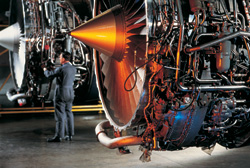
Gas turbine engines power a number of different things, from aircraft to power plants. These engines must perform at extremely high operating temperatures, well over 1000 degrees Celsius. Hence, the thermal stability of the engine's components is of utmost importance in order to avoid fatigue or failure. The GROWTH Programme sponsored the HIPERCOAT project which brought together experts from both Europe and the United States to advance state-of-the-art in Thermal Barrier Coatings (TBCs). TBCs are used to prevent damage to gas turbine engine components. HIPERCOAT partner Office National d'Etudes et de Recherches Aerospatiales (ONERA) was responsible for developing new thermal conductivity models to aid in the development of novel TBCs. The first model applies Non Equilibrium Molecular Dynamics (NEMD) to estimate the thermal conductivity of complex oxides. The model addresses the molecular scale and accounts for the influence of temperature. ONERA calibrated its model using an yttria-zirconia TBC and then calculated the thermal conductivity of a number of different materials, including ternary zirconias, perovskites and others. ONERA also used its expertise to create a second model appropriate for any heterogeneous substance. FDM analysis of 2-D and 3-D images breaks the area or volume down into segments. These pixels, or voxels, correspond to a single substance whose thermal traits are known. The model then employs numerical methods to perform a bottom-up estimation of the overall thermal conductivity. The model was optimised for fast performance, with only 5 CPU hours necessary to process 100 million voxels. These models proved vital in the assessment of new TBCs by the HIPERCOAT consortium.