


Fusion EAG urges EU to pursue a strong energy policy
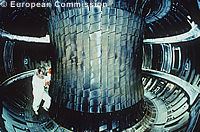
The European Union should pursue a strong energy programme, in which research into controlled fusion plays a major role, the external advisory group (EAG) to the European Commission's Fusion programme advises in its latest opinion. 'The EU should also do all that is possible and reasonable to site the next large fusion experiment in Europe,' it says. Research on nuclear fusion is currently funded under the Euratom programme and managed under the umbrella of the energy, environment and sustainable development component of the Commission's Fifth Framework programme. The EAG supports this action and recommends that the Commission vigorously pursues its current R&D activities in the fusion field. 'As fusion research is a long-term undertaking, still too far away for private investments, public funding is vitally important for continued success over the next two or three decades,' says the EAG. 'After that time, controlled fusion will be within the time scale of predictable commercial application as an energy source.' The EAG also believes that the focus of the programme should remain reactor oriented. And it endorses the strategy which includes activities in fusion physics and technology, focusing on the construction and operation of the 'Next Step' ITER 'as a necessary step towards a demonstration plant....since the successful integration of physics and technological issues will prove the technical feasibility of fusion power.' The group goes to some length to stress the importance of examining every avenue that may lead to long term and safe sustainable energy supply for future generations. Despite a noteworthy decrease in energy intensity, global energy requirements are expected to multiply because of growth in the global economy, says the EAG. This means that as supplies of fossil fuels dwindle it is imperative to improve energy efficiency. 'The only mature greenhouse gas free electricity generation source is nuclear fission,' it says. 'It should be clear that the sensible approach to future energy provision is not an either-or,' but an 'and-and' philosophy,' according to the EAG. '[...] fossil fuels, renewables, fission and fusion, should be further explored and developed so that future generations can choose the composition of an appropriate energy source basket.' The EAG describes scientific progress in the field of fusion research as remarkable: 'All available techno-scientific information shows that steady and significant progress is being made towards a successful reactor.' But fusion power generation is a long way in the future and will take a long time to achieve, it says, not least because of the cost of building and operating large experimental devises, such as ITER. More money could mean more progress. 'Political decisiveness is required to keep the time schedule.' The tokamak design (of which ITER would be the main representative) is presently the best option for success, say the experts. But they also support further research on alternative concepts and endorse strategies to supplement Next Step activities with long term material research on low-activity and radiation resistant structural materials and super-conducting materials, amongst others. An international approach to fusion research must continue as must research on the safety and environmental aspects of fusion power, they continue. The experts would like to see more industrial involvement in fusion research. 'Due attention should be put on meeting the European Union utility requirements for future power plants. The best way to achieve such is to involve the industry heavily in the design and construction activities of the Next Step.' Europe's lead in fusion research would be confirmed and strengthened by a site for ITER within Europe, the group concludes. And if this proves unaffordable, it would prefer to see it built in Canada before Japan. Finally the EAG expresses its concern at the public's apparent unawareness of the seriousness of the long-term energy problem and it urges the Commission services to increase efforts to communicate this to the media, the public at large and its elected representatives.