


Innovation is the key to competitiveness, says Liikanen
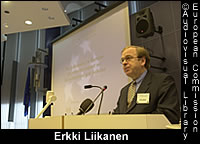
EU Enterprise Commissioner Erkki Liikanen made it clear on 22 November that innovation will have to play a key role if the EU is to close the competitiveness gap with the USA, as highlighted in the 'European competitiveness report' published on the same day. The report identifies two major causes behind the EU's lack of competitiveness in comparison with the USA: a weakness in innovative performance and a slower introduction of new technologies. Competitiveness in this report is understood as a sustained rise in living standards and as low a level of unemployment as possible. The report highlights three areas in which the USA is significantly ahead of the EU: biotechnology, manufacturing and the ICT sector. To be competitive in biotechnology, an innovative capacity is crucial, said Mr Liikanen. The report states that 'innovation is a complex process intertwined with factors such as the strength of the knowledge base, institutional arrangements, qualifications of the labour force, openness of the economy and an overall ability to take on board improvements achieved in other countries or sectors.' The report also states that in addition to innovative activities, a country can also boost its economy through successful innovation diffusion. Innovation diffusion is clearly facilitated by networks. Successful biotechnology networks have developed within the EU, particularly around Cambridge in the UK, Paris in France and the Bavarian region in Germany, said Mr Liikanen. Unfortunately, added the Commissioner, one of Europe's weaknesses is that the EU's biotechnology firms are too small and too specialised in specific niches. Also, the report highlights that new European dedicated biotechnology firms tend to be smaller than their US counterparts, less active in global networks and collaborative relationships and less present in markets for these technologies. The attractiveness of the EU for US researchers must also be tackled if Europe is to catch up with the USA, claims the report, stating 'the apparent unattractiveness of Europe to US research appears to be particular to biotechnology.' A crucial element for a competitive biotechnology industry is a strong research and development sector. 'Without a strong and diversified scientific research base, no technological take-off is possible,' states the report. The report recommends that competitiveness in the EU's biotechnology sector be boosted through higher levels of research funding, more pluralism in funding sources, lower dependence on closed national systems and higher integration of research with teaching, clinical research and medical practice. Innovation is also vital for a competitive manufacturing sector as it enables a higher productivity rate. During the 1990s, growth in production and labour productivity in manufacturing in the EU was far below that of the USA. Four countries however did experience growth rates above those of the USA: Ireland, Finland, Austria and Finland. R&D is again important for the manufacturing sector, as the report states that 'research intensity and productivity growth are significantly related across sectors.' The report adds that 'when research intensity and productivity growth are brought together across sectors in the US and the EU, the evidence is that high research intensity is never associated with low productivity growth, and low research intensity is usually associated with low productivity growth.' The report ends its analysis of manufacturing competitiveness on a positive note, stating that it is 'virtually certain that substantial gains from information technologies and the associated innovations will be possible in the future.' ICT investments in the EU have been significantly smaller than in the USA. In 1999, the EU was investing 2.4 per cent of its GDP compared with 4.5 per cent in the USA. Indications are that the EU may have missed out on between 0.3 and 0.5 percentage points in annual GDP growth because of this lower level of ICT investment. Spending does however vary considerably between Member States, with that of the UK and Sweden already having overtaken that of the USA. The Netherlands, Denmark and Ireland have also almost equalled ICT spending in the USA in terms of a percentage of GDP. This gives extra weight to the report's claim that 'the magnitude of ICT expenditure and investment in a nation may be more important for growth performance than the size of the corresponding ICT producing sector.' This will be welcome news for those countries with a low level of technology production. The report asserts that complementary policies are necessary if the benefits of new technologies are to be reaped. These include the upgrading of labour force skills, encouraging the mobility of scientific and technical personnel across sectors, modernisation of the regulatory framework and strengthening the interdependencies characterising technology and innovation systems. More action is still needed on Internet access and liberalising telecommunications in the EU, said Mr Liikanen. 'It is strikingly clear that those countries which were the slowest in liberating their telecoms systems are paying higher costs and Internet penetration is slower in these countries,' he said. 'If you don't liberalise fast, if you don't create competition, you lose fast in the economic development of your country. 'All in all, the report shows that we need to run further with the EU action plan to make the Internet accessible to all,' the Commissioner added. The report concludes by recommending that a systematic approach be adopted in order to improve Europe's competitiveness. It adds that this should be twinned with a strengthening of basic scientific research, the integration of research and industry and sustaining the creation and development of dedicated biotechnology firms. Also necessary is attention to the issue of intellectual property rights, concludes the report.