


Accelerating agroecology and organic farming for a more sustainable agri-food system


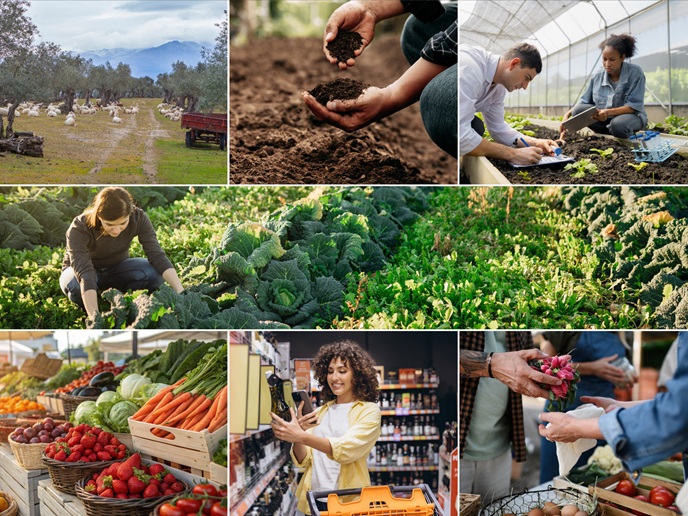
Agroecology and organic farming are holistic approaches that rely on and maximise the use of ecological processes to support agricultural production. As such, these approaches can help mitigate climate change and at the same time strengthen the sustainability (economic, environmental, climate, social) and resilience of farming. The systemic approach has implications for the whole span of agricultural practices, from cultivars used, to soil management practices, integration in value chains and locally adapted business models. This new CORDIS Results Pack highlights 12 EU-funded research and innovation activities focusing on how agroecological approaches and organic farming can be a key enabler to boost more sustainable farming in Europe.
A more sustainable, resilient agri-food system
Agroecology has the potential to become a fundamental tool for a more sustainable and resilient farming sector that can respond to the needs of climate and people. Agroecological practices are among the ones that can be supported through the eco-schemes under the first pillar of the common agricultural policy(opens in new window), and singled out as one of the sustainable approaches with the potential to contribute to achieving the ambitious targets of the European Green Deal(opens in new window). Moreover, under the Green Deal, the EU action plan for the development of organic production(opens in new window) was published. The plan places a strong focus on R&I to boost the organic farming sector. More recently, the EU’s Vision for agriculture and food(opens in new window) has highlighted the role of organic and agroecological farming in making agriculture an attractive activity for current and future generations, combining economic possibilities with environmental results and social responsibility. The Vision has also highlighted the key role of research, knowledge, innovation and skills for Europe’s agri-food economy. Consequently, the EU is boosting its support for agroecology and organic farming research to foster a deeper understanding of how these sustainable approaches can foster competitive, sustainable, resilient and fair farming systems. Under Horizon 2020, several dedicated R&I projects contributed to a better understanding of agroecology’s and organic farming’s potential, and this work continues under Horizon Europe, with increased support to R&I in these approaches. One of the examples is the AGROECOLOGY Partnership. Launched in January 2024, the Partnership is joining forces of EU countries and regions as well as several other key actors to drive the transition towards sustainable European farming systems. Boosting the transition towards agroecology builds on the knowledge and advances of organic farming, the best-known farming approach and closest to agroecology. At the same time, organic farming is benefiting from research in agroecology to further boost its sustainability and competitiveness, in line with the EU action plan for the development of organic production. R&I integrating agroecology and organic farming are a win-win for both approaches. The Pack opens with the flagship European R&I AGROECOLOGY Partnership, an EU-wide endeavour that taps into the potential of agroecology to accelerate the transition towards a sustainable, climate and ecosystem-friendly farming system. The projects AFEU, AGROMIX and Grazing4AgroEcology each explore the contributions that mixed land use systems offer in terms of economic benefits, ecosystem services and reduced inputs. The contribution of digital tools to agroecological practices and organic value chains is a key focus, including improved labelling and traceability ALLIANCE and THEROS, as well as broader applications in D4AgEcol and PATH2DEA. The OrganicTargets4EU project modelled future scenarios of organic farming and organic aquaculture in the EU, while Oper8 explored how to boost the adoption of sustainable alternatives to chemical weed control. Finally, the need for a greater availability of cultivars developed for organic farming systems is the focus of the InnOBreed and LIVESEEDING projects.
