Is AI more creative than us?

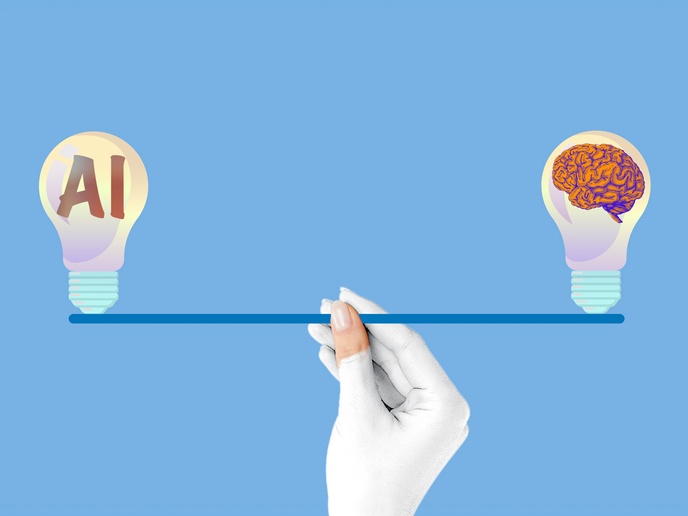
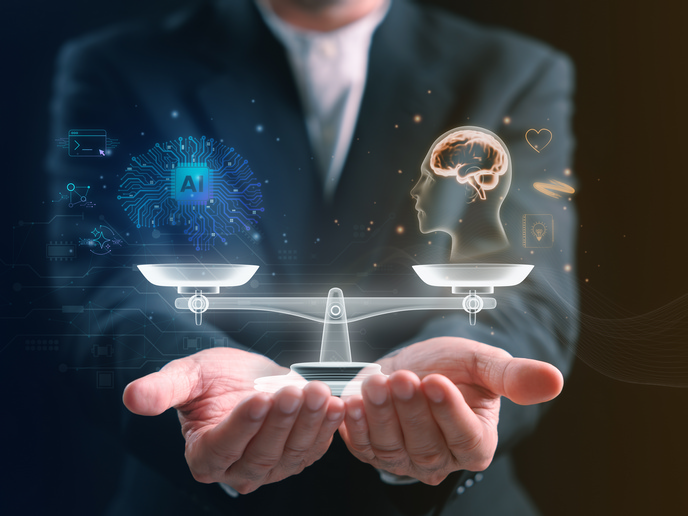
We’ve always viewed creativity as a unique by-product of human consciousness, as a defining human trait. This is what separates us from the tech world and machines. However, recent research has shown that ChatGPT can already outdo the average person on creative tasks. Can machines match or even surpass human creativity? Are creative individuals such as writers, designers and artists going to be replaced?
AI versus human creativity
A research team led by Karim Jerbi from the Department of Psychology at the University of Montreal in Canada carried out the biggest comparison between human and machine creativity up to now. Using a standard creativity test, they pitted over 100 000 participants from Australia, Canada, New Zealand, the United Kingdom and the United States against nine of the most advanced AI systems. The results revealed that GPT-4 scored higher than the average human on the test. Google’s Gemini Pro matched average human performance. However, GPT-4 kept using the same words again and again. ‘Microscope’ appeared in 70 % of its responses, followed by ‘elephant’ (60 %). Because it was natural for the volunteers to avoid repeating themselves, the most common word was ‘car’ (1.4 %), followed by ‘dog’ (1.2 %) and then ‘tree’ (1 %). “Even though AI can now reach human-level creativity on certain tests, we need to move beyond this misleading sense of competition,” explained study co-author Jerbi in a news release(opens in new window). “Generative AI has above all become an extremely powerful tool in the service of human creativity: it will not replace creators, but profoundly transform how they imagine, explore, and create — for those who choose to use it.” As part of the test, the volunteers were asked to name 10 words in under four minutes that are as unrelated to each other as possible. An individual scored higher on creativity when the meanings of the words were further apart.
Creative talent triumphs
On the other hand, the top 10 % of creative people consistently outperformed every tested AI system. The findings were published in the journal ‘Scientific Reports’(opens in new window). The researchers also tested AI models and humans on creative writing tasks, including haikus, film summaries and short stories. Here too, the most creative individuals outperformed AI, especially in poetry and plot synopses. An interesting outcome was that GPT-4 Turbo, a faster, cheaper and more improved version of GPT-4, performed much worse on the test. This means that newer AI models aren’t necessarily more creative. The researchers suggest that the reason for this is newer releases are engineered for greater speed and cost-effectiveness, possibly at the expense of creativity. “Our study shows that some AI systems based on large language models can now outperform average human creativity on well-defined tasks,” commented Jerbi. “This result may be surprising — even unsettling — but our study also highlights an equally important observation: even the best AI systems still fall short of the levels reached by the most creative humans.” “By directly confronting human and machine capabilities, studies like ours push us to rethink what we mean by creativity,” he concluded.