Farm-based solutions to tackling micronutrient deficiencies

Selenium (Se) deficiency is an under-reported nutritional issue that impacts large parts of the population. It is mainly caused by an absence of this essential trace element in soils and crops – a situation that may worsen with climate change. This presents a health challenge. Inadequate dietary Se intake can lead to mental fatigue and muscle loss and has been linked to an increased risk of developing chronic degenerative diseases. Traditional supplementation strategies are often inefficient because of low bioavailability (a measure of how the body absorbs substances).
Plant biofortification and enriched dairy products
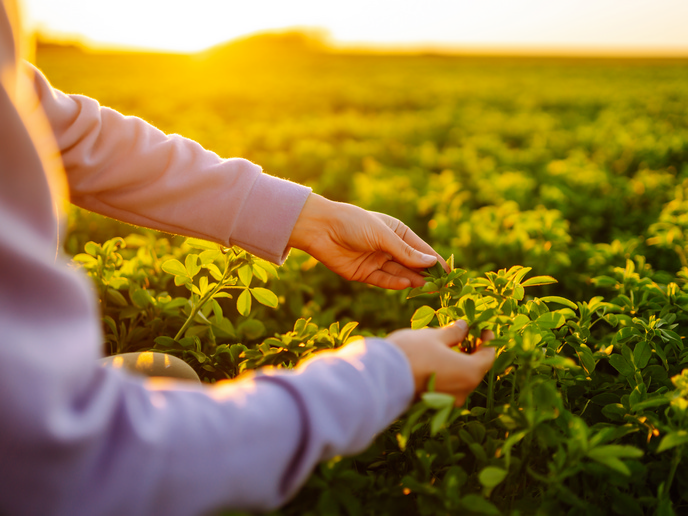
To address this, the Se4All(opens in new window) project, which was supported by the Marie Skłodowska-Curie Actions(opens in new window) programme, sought to develop sustainable, food-chain-based approaches to increasing Se intake. Crucially, the project went beyond plant biofortification by demonstrating the full transfer of Se across the food chain, from crops to animal feed and ultimately to dairy products intended for human consumption. “The aim from the start was to provide a safe, natural and effective way to deliver bioavailable selenium through widely consumed foods,” explains project coordinator María Jesús Sánchez Martín, a professor from the Autonomous University of Barcelona(opens in new window). “For this, we brought together a highly multidisciplinary consortium including experts in agronomy, analytical chemistry, food technology, dairy production and large-scale research infrastructures.” Work included developing and applying Se formulations to alfalfa, using foliar treatments (i.e. treating leaves). These experiments were validated in both controlled conditions and open-field trials. Enriched alfalfa was then used in feeding trials with dairy cows, to demonstrate the transfer of Se into milk. “Advanced analytical techniques, including HPLC-ICP-MS and synchrotron-based methods, were used to study selenium along the plant–animal–milk chain, in order to confirm the formation of bioavailable selenium forms,” says Sánchez. “We also assessed the functional, microbiological and sensory properties of the resulting dairy products to ensure industrial feasibility and consumer acceptability.”
Successful ‘soil-to-food’ approach
The Se4All project successfully demonstrated the viability of its ‘soil-to-food’ approach. Production of Se-enriched alfalfa was achieved without negatively affecting plant growth or nutritional quality. The team was also able to show the efficient transfer of Se from feed to milk, significantly increasing Se levels while maintaining safe and nutritionally relevant concentrations, to produce Se-enriched milk. “We were able to confirm that selenium enrichment does not compromise milk quality, safety or processing performance,” notes Sánchez. “Selenium-enriched dairy products like milk powder, cheese and yoghurt were produced with preserved sensory and microbiological quality.” Importantly, these products can be obtained without requiring major modifications to existing dairy processing technologies, supporting their scalability and industrial adoption. Overall, the project demonstrated that Se biofortification through the agri-food chain is both feasible and scalable.
More resilient food systems
Next steps include further studies into Se stability across different dairy products, as well as evaluating the long-term stability and bioavailability of Se during storage and processing. Scaling up production of Se-enriched dairy ingredients (such as milk powder) will also help to ensure industrial viability. “For this, we are looking to strengthen collaboration with dairy farmers and industry stakeholders,” remarks Sánchez. “We also want to expand our research into the health benefits of regularly consuming selenium-enriched dairy products.” Over the long term, Sánchez hopes that the Se4All project’s results will contribute to more resilient food systems and help address global challenges related to nutrition, sustainability and climate change. “Our approach has the potential to improve public health, support the dairy sector with value-added products, and reduce reliance on conventional supplementation,” she says.