Non-destructive measurements of coating properties

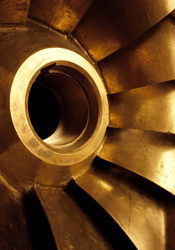
The HIPERCOAT project focused on the design, performance and durability of thermal barrier systems. Due to their chemical and thermal features, thermal barrier components constitute materials of great importance for the gas turbine industry. Their key benefit relies on their ability to prevent thermo-mechanical fatigue and oxidation. This capability limits degradation of and offers protection to the underlaying structural superalloy material. Within the scope of this project, an innovative measurement technique (phase of thermal emission spectroscopy) was realised to specify the thermal properties of thermal barrier coatings. Based on non-destructive infrared thermography, the technique uses laser excitation for inducing harmonic heating in the coating. The thermal emission of the coating material is highly related to the resulting temperature field. The novel technique offers determination of several coating quantities. Such quantities include thermal parameters of the film, such as thermal diffusivity and the effusivity contrast between the film and substrate. These quantities were further employed to calculate the thermal conductivity and the volumetric heat capacity of the film. Furthermore, the measurement technique may be well employed for mapping the characteristics of the coating material. The phase of thermal emission spectroscopy method is sensitive to interface thermal contact, structural aging, structure defects and coating thinning. Therefore, the technique may be used for the detection of the defects, such as decohesions near the interface, without destroying the coating material. Moreover, the method can also provide estimations of the relative depth of a defect in the coating. For further information, click at: http://www.materials.ucsb.edu/~nsf/(odnośnik otworzy się w nowym oknie)