Realising nano-scale biodevices

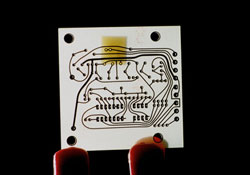
The interdisciplinary research team of the SAMBA project joined forces to fabricate and demonstrate a biomolecular transistor consisting of self-assembled metalloproteins. Metalloproteins are protein molecules containing a metallic chemical compound and feature redox (reduction/oxidation) chemical reactions, that is, changes in the oxidation state through the gain or loss of electrons. The project work involved ultra-high resolution electron beam lithography and suitably engineered metalloprotein layers of a controlled density in the limit of a single molecule. More specifically, type I copper proteins such as azurin, plastocyanin and their suitably designed mutants have been employed. These metalloproteins are capable of self-assembling on different solid or soft substrates and form a channel. The drain-source current through this channel is controllable via changes of the gate voltage. This can change within a range around a certain value which is related to the equilibrium potential of the redox state. This hybrid metalloprotein/metal system with a gate potential into the channel of a field effect/single electron transistor is the key concept behind the project work. On the basis of this functionality of rectification and amplification of electrical signals using metalloproteins, different types of biomolecular electronic devices have been implemented. The devices feature small metallic nanoelectrodes on slicon/silicon dioxide substrates and on these substrates proteins have been chemisorbed. Extensive testing of the devices provided a better insight into the self-assembly of the molecular layer and the chemisorption process as well as aspects of protein stability. In addition, new protocols for the fabrication and testing of nanodevices have also been formulated. The project results provide the grounds for exploration of new research areas such as the realisation of single-molecule three-terminal devices or the refinement of the model for the protein-layer transistor. Most importantly, the new methodologies and new knowledge gained at the boundary between nanotechnology and biology/biochemistry fields open new avenues in the field of nano-biolotechnology. Examples include lab-on-chip devices for genomics and post-genomics, design of novel molecular architectures through bio-self-assembly and molecular computation.