


ERA 'panacea' needs to be monitored - MEP
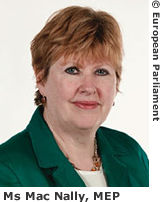
The European Research Area (ERA) is long overdue but also needs to be carefully scrutinised to ensure it benefits everyone, according to a prominent member of the European parliament (MEP), talking exclusively to CORDIS News. 'We need science driven by society, not society driven by science,' says Mrs Eryl McNally, MEP, who has long held an interest in the development of research. She has participated in debates and served on parliamentary committees on research, genetics, environment and women in science and also presented a parliamentary report in January concerning energy efficiency. 'It is good to go beyond the Framework programme,' she said, 'if we want to be competitive vis-à-vis the USA and Japan, we need to do more,' she said. This includes avoiding replication and taking advantage of the 'clever people all over the EU'. Asked if she sees the ERA as a possible panacea to bridge the research and development (R&D) gap with these countries, she replies: 'Very much so. We punch below our weight.' But she also recognises that the ERA cannot change things without the cooperation of the Member States. One of the main reasons for lagging behind the USA and Japan is that Member States, with the exception of Finland and Sweden, invest less of their GDP on research and development than the USA or Japan. 'Frankly, whatever the EU does, it won't make much difference unless the Member States realise the sense of investing in research...it's time to show that we can be among the best researchers in the world.' She recognises that there are many elements required to bring about a true ERA. Networking of centres of excellence with high speed links, providing for greater researcher mobility and opening up of national programmes are all fundamental. This final point will be a test, according to Mrs McNally. 'I think there is no need to be frightened. They will only add value by opening them [research programmes] up - they're not going to get completely swamped.' She also recognises that there are areas which are not appropriate for sharing, such as defence research, but points to the example of the USA which is successful as it 'takes every advantage of bringing in people from other countries.' But the ERA, while providing a key tool in bridging the gap between the USA and Japan, needs to be closely monitored. And Mrs McNally sees the European Parliament as the perfect institution to carry out this task. 'Parliament is the voice of the people, it is directly elected...we are entitled to say what is money being spent on, particularly public money, what sort of research is being done, is it being properly evaluated and are we getting a good deal for our money?' The Parliament has already set in motion a system by which various research lines can be monitored by individual MEPS, a pilot project that Mrs McNally says will be done better next year. But she also feels that it would make sense if the European Parliament were involved in official evaluations. 'There would be no harm in that at all,' she says. Finally, she recognises that concerns have been expressed by smaller players, that the ERA's focus on large projects may leave them out in the cold. 'I have some concerns too,' she says. 'Many researchers in smaller centres have told me that if there is an overwhelming emphasis on larger projects, that, unless there is a determined effort to include smaller enterprises from outside the large centres, then it could be very dangerous - many of the breakthroughs do not come from the large centres or prestigious universities or industries, they come from very small undertakings...so I will want a lot of assurances before I agree to saying only large projects will be funded.'