


JRC acts on enlargement priority pledge
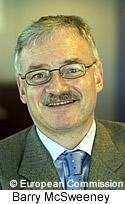
Joint Research Centre (JRC) Director General Barry McSweeney and Research Commissioner Philippe Busquin have taken action to emphasise the key role of EU enlargement in European research policy. 'Enlargement is one of the most important opportunities for the European Union as it enters the 21st century,' wrote Philippe Busquin in a JRC newsletter. 'Research and development is at the leading edge of this process and paves the way to a harmonised integration of our partners into a peaceful and more prosperous and powerful Union.' Since assuming the post of JRC Director General in April 2001, Barry McSweeney has also been keen to stress that the enlargement process is of top strategic importance for the JRC. His plans for the organisation include supporting the adaptation of candidate country research policy to conform to the EU framework and assistance with their integration into the European Research Area (ERA). As part of the JRC Futures project, a seminar will be held in Prague on 18 and 19 September. This will be followed by an information day on 20 September. The Futures project, which focuses on the techno-economic and societal impact of enlargement, was initiated at the suggestion of a high level expert group meeting in September 2000. This informal network of experts, all of whom had access to high level decision makers in the candidate countries, met for the first time in June 1999. The group aimed to initiate a dialogue on science and technology developments and their link socio-economic issues affecting the candidate countries and the EU. The project began in January 2001 following a project steering group brainstorming session where over 80 topics were put forward for investigation. The topics were clustered into four thematic groups, each of which has a panel carrying out research in this area. The panel includes members from EU Member States, candidate countries and elsewhere and represent academia, research institutes, the media, research and development (R&D) company departments, national and regional governments, European institutions and non-governmental organisations (NGOs). The four panels are: - Economic transformation (industry, agriculture, trade, services, measurements); - Employment and social change (demography, health, diversity, cohesion, boundary conditions); - Technology, knowledge and learning (education and skills, intellectual capital, brain drain, science and technology, information and communication technologies); - Sustainability, environment and natural resources (energy, water, mobility and transport). The Prague seminar in September represents the half way stage of the project and will discuss the results so far. The final results will be discussed in Bled, Slovenia, in November this year. The information day in Prague on 20 September will present recent JRC achievements and future plans to delegates from research organisations in the Czech Republic. The aim of the event is to promote a structured dialogue, identify potentially interested partners and pave the way for enhanced collaboration. The organisation of events is just one of the ways in which the JRC is fulfilling its pledge to keep enlargement as a top priority. It has recently launched a new website providing information on JRC enlargement activities and relevant links for candidate country researchers. These include national contact points, scientific attachés of applicant country missions to the EU, and the policy support unit responsible for the JRC's enlargement support action. The enlargement support action, initiated in 2000, includes the progressive opening up of the JRC programme to candidate countries, the encouragement of joint proposals for the Fifth Framework Programme (FP5) and the organisation of joint events. The JRC has also recently selected six additional applicant country experts and published a call for interest for JRC scientific fellowships open to associated-State candidates, and an invitation to apply for an individual fellowship at the JRC under the Marie Curie programmes. Pre-accession countries will face a rapidly changing political and economic environment over the next decade, and enlargement will bring new challenges with new consequences. Those forming EU research policy hope that the JRC can play a part in providing policy support to deal with some of these challenges.icipating in EU research