


Commission announces action plan to counter nuclear, biological and chemical terrorism
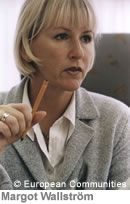
EU Environment Commissioner Margot Wallström has welcomed an anti-terrorism action plan drawn up at an extraordinary meeting of director-generals of civil protection in Knokke, Belgium, on 11 and 12 October. The European Commission-chaired meeting focused on the response civil protection authorities should take in the case of a wide ranging terrorist attack, particularly using nuclear, biological or chemical agents, in the EU or elsewhere. It resulted in the drawing up of a new two-phase action plan to reinforce Community cooperation in responses to terrorism. The first phase of initiatives, to be put in place by 31 October this year, aims to set up a Community mechanism to reinforce cooperation between national civil protection authorities. The scheme includes: - the creation of a group of nuclear, biological and chemical experts (NBC) who would be available 24 hours to help any country which needs advice; - the upgrading of the existing network of contact points to enable it to deal with round the clock requests. National and Community structures will also be connected by dedicated telephone lines as far as is possible. - better inter-agency cooperation on both national and Community levels, particularly with health services, with a view to collecting information on vaccines, antibiotics and other medications, the availability of hospitals in the case of attack, and the exchange of information on Member State prior warning systems; - the setting up of a task force of national experts which will help the Commission's civil protection unit to create a surveillance and follow-up unit set out in the initiative. The second set of initiatives will get underway with a workshop organised by the Belgian presidency of the EU at the beginning of December 2001. This workshop will be responsible for drawing up a short, medium and long term work programme, including research, to enable Member States to deal effectively with a nuclear, biological or chemical terror attack. The Commission will organise and finance a forum of Member State experts to set up the programme drawn up by the presidency workshop. Furthermore, a self-training system will be set up to prepare operational workers to deal with any widespread terrorist attack, particularly nuclear, biological or chemical attacks. This programme will aim to share the lessons learned by professionals working in the field. Delegates at the meeting, from Member State, EEA (European Economic Area) and candidate countries, also highlighted that civil protection responses to a terrorist attack remain the responsibility of EU Member States and that national plans of action are currently being adapted to cope with the heightened risk of attack following the events of September 11.