


EU project opens children's eyes to the wonders of science
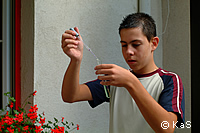
In recognition of the need to get young children more involved and interested in science, the Commission is funding a pilot science village, designed to show that science is not only an important part our everyday lives, but also an exciting and enjoyable subject. The Kids and Science (KaS) Accompanying Measure has received 250,000 euro under the 'improving human research potential and the socio-economic knowledge base' programme of the Fifth Framework Programme. The project is targeted at children between the ages of 12 and 14, and is divided into two parts: a virtual, Internet based 'science city' and a real 'science village' located high up in the Austrian Alps. In an interview with CORDIS News, Dick Wife, project coordinator, explained the main focus of KaS: 'We chose to develop an interactive and exciting environment that would be alternative yet complementary to scientific activities in school.' 'Children tend to see science in an abstract way and very often, science gets lost in the school system. The goal of our project has been to provide children with activities not normally associated with school,' he added. The two elements of the project are also designed to provide preparation and continuity to the children who participate in the pilot scheme. 'KaS uses the Internet as a primary tool to prepare the children for a week in a science village, as well as to provide them with essential continuity after this experience.' The virtual city consists of a forum and a series of interactive tasks and tricks based on seven topics: life, transport, water, air, energy, materials and food. 'A myriad of information is on offer, such as how dynamite goes bang, why you look like your dad or mom, how food keeps us alive, molecules behave, planes fly, what the Earth is made of and loads more fun stuff,' explained Dr Wife. 'The web site is also designed in a way that lets children call the shots. They are encouraged to really get involved and contribute to building the activities online,' he added. The second part of the scheme, the science village, welcomed its first group of children in August. A total of 20 children were selected from a number of Austrian schools to take part in the week long programme of activities, which included special workshops with scientists and inventors. The children were given basic information on one of a number of topics related to natural sciences and were then asked to carry out the experiment. 'The accent here was on the kids doing the activities themselves,' said Dr Wife. 'The goal wasn't to spoon-feed them the answers: the role of the scientist was to guide the children in the right direction.' Feedback from the teachers, scientists and children has been very positive and plans have already been made for a school reunion in October. 'However, one element which may have to be reconsidered is the length of time scientists stay at the village. 'Children are very wary of strangers and need time to build up a trusting relationship,' explained Dr Wife. 'Next time, we will need to think about extending the time that staff and scientists spend at the village.' Dr Wife believes that a concept like the science village which helps children build up their confidence is one that should be extended to other countries in Europe. 'It is also an initiative in which industry and national governments should involve themselves,' noted Dr Wife. Mindful of this, the KaS consortium is currently examining the possibility of demonstrating their concept at the European Science and Technology week in November.
Kraje
Austria, Netherlands