


EU awards young scientists
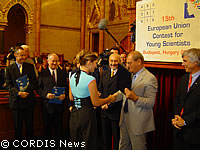
The award ceremony of the 15th EU contest for Young Scientists took place on 25 September in Budapest, Hungary. Following a week of deliberating over a total of 75 exhibitions, an international jury composed of 11 scientists awarded three first prizes, each worth 5,000 euro, to three young scientists from Germany and Hungary. Three second and third prizes, as well as four honorary awards and seven special awards, were also presented. The total prize money amounted to 28,500 euro. Chairman of the jury, Ulf Merbold, from the European Space Agency, told CORDIS News that selecting the winners had been extremely difficult given the variety in terms of the disciplines represented and their outstanding quality. 'Overall I am truly impressed by this year's entries,' he said. 'I think that this is the vanguard of the future European scientific community.' Uwe Treske, an 18 year old secondary school student from Hamburg was rewarded for his project on a low cost tunnelling microscope, which he designed with a mere 50 euro. Equally innovative was the development of a set of high fidelity loudspeakers using plasma, by the 19 year old Hungarian prize winner, Gábor Németh. Jana Invanidze, 19, also picked up first prize for her investigation into the internal pH of endoplasmic reticulum, a cell organelle involved in protein synthesis. Her results may help to develop hormone therapy in the future. The contest is part of the 'science and society' programme of the Sixth Framework Programme. Its aim is to encourage young people to pursue their interest in science and embark on a scientific career. However, some of the prize winners did not seem to need encouragement. Ms Invanidze told CORDIS News that she started working on her project almost five years ago when she was drawn to biology and chemistry. 'I wanted not only to read books but to see what it is like to work in a laboratory,' she said. 'I got on a lot of people's nerves until I was let into a laboratory at the University of Munich,' added Ms Invanidze. Thanks to the help of an open minded professor, Ms Invanidze had the opportunity to participate in a number of ongoing projects at the university and learnt a great deal about molecular biology and biochemistry. Although very excited about winning the prize, Ms Invanidze said that it has not altered her plans to start a degree in medicine this autumn. 'Of course it is very motivating that a jury of such high level considers my work the best,' she told CORDIS News. 'It has added to my desire to do a doctorate after my degree.' Presenting the awards, Research Director-General Achilleas Mitsos said that he was very encouraged by the palpable enthusiasm for science among the contestants. 'Young people and science are the future,' he said. 'There is a very simple equation: For the EU to grow, science must be our main preoccupation.' However, Mr Mitsos noted that science cannot be imposed upon society: a dialogue between the public and science must be a prerequisite. 'Young scientists should be considered a crucial element to this dialogue,' he said. 'If we cannot find a way to make scientific careers attractive and science fun again for young people, we will have failed.' The Commission is investing 80 million euro in activities to improve communication between science and society. 'This contest is just one element of a complex policy we are trying to develop for promoting science,' Mr Mitsos told CORDIS News, noting that a number of projects are currently being finalised which will look at how scientific teaching practices can be improved in primary schools.
Kraje
Hungary