


SMART-1 begins its journey to the Moon following 'flawless' launch
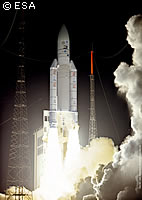
Europe's first ever Moon orbiter got off to a flying start on 28 September, following what the European Space Agency (ESA) described as a 'flawless' launch for Ariane flight 162 and it's SMART-1 payload. The SMART-1 (small missions for advanced research technology) spacecraft has achieved its initial Earth orbit, deployed its solar arrays, and is undergoing systems checks prior to firing its innovative ion engine for the first time on 30 September. Following the launch from Europe's spaceport in Kourou, French Guiana, ESA Director General Jean-Jacques Dordain said: 'Europe can be proud, we have set course for the Moon again.' The ion engine being used on SMART-1 will fire almost constantly for a period of around 80 days, stopping only when the spacecraft's solar panels are rendered powerless by the shadow cast by Earth. In late December 2004 when the probe is 200,000 kilometres from Earth, it will perform three gravity assisted fly-bys of the Moon, eventually being 'captured' in a near polar elliptical orbit in March 2005. Although the ion engine will only accelerate SMART-1 at a rate of 0.2 millimetres per second squared, it will eventually propel the orbiter to speeds far in excess of those possible using traditional chemical propulsion techniques. The technology is expected to lay the foundations for future European deep space missions. As well as the novel propulsion system, SMART-1 employs a wide range of innovative technologies, including a new generation deep space communications system, and a computer technique that allows spacecraft to determine their position autonomously in space - the first step towards fully automated navigation. Once it reaches the Moon the probe will conduct observations never performed before in such detail, providing vital information on the evolution of the Earth's satellite, its chemical composition and its geophysical processes. It will also take part in an experiment to try and detect an incoming laser beam being sent from the Teide Observatory in the Canary Islands. ESA director of science David Southwood said: 'Science and technology go hand in hand in the exciting mission to the Moon. The Earth and the Moon have over four thousand million years of shared history, so knowing the Moon better will help scientists in Europe and all over the world to better understand our planet and will give them valuable new hints on how to better safeguard it.' On 27 September, three lightweight UK built satellites which will form part of the disaster monitoring constellation (DMC) were successfully launched on board a Russian Kosmos rocked and placed into Earth orbit, where they will provide rapid assistance in the event of droughts, earthquakes, fires, and man-made disasters.