


EBS communicates business reality to policy makers, claims summit founder
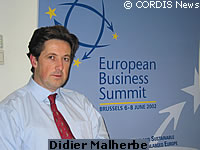
According to Research Commissioner Philippe Busquin, the European Business Summit (EBS) is the 'ideal platform' for dialogue between research and innovation stakeholders. Yet the event's founder and managing director, Didier Malherbe, looks forward to the day when he no longer has to organise this biennial event. As the final preparations are being made for this year's summit in Brussels on 11 and 12 March, CORDIS News spoke to Mr Malherbe, and asked him why, after only two previous instalments, he feels the event has become a point of reference for business people and politicians alike. 'Even though their goals may be mutually compatible, policy makers and business leaders occupy different realities,' Mr Malherbe began. 'Ultimately, businesses are there to make money, while policy makers are more focussed on the increased growth and employment that tend to follow profitability.' Therefore, he explained, the most fundamental aim of the EBS is to bring both groups together to promote a better mutual understanding. Asked what makes this summit different from other consultation processes or events organised by the political institutions themselves, Mr Malherbe highlighted the 'business mentality' of the summit. 'We will try to avoid generalised discussions on the Lisbon Strategy, for example, in favour of presenting delegates with examples of current realities and trying to identify concrete answers,' he said. In the spirit of bringing business and policy closer together, the EBS has dual objectives and benefits for each party. For businesses, especially small and medium sized enterprises (SMEs), the event represents a very efficient means of communicating their daily reality to politicians and gaining future perspectives on fast moving areas of research such as biotechnology, nanotechnology, and environmental technologies. It is also an ideal opportunity to learn about the opportunities offered by public initiatives, such as the Commission's Sixth Framework Programme. For their part, political institutions welcome the opportunity to drive home to the private sector the importance of investment and cooperation in research and innovation activities. Furthermore, the benefits of personal interaction with business people are recognised by political institutions within the EU, where many individuals may have little direct experience of the private sector, according to Mr Malherbe. For him, one of the most positive signs that the EBS is as equally valued by policy makers as it is by companies was the initiative taken by the Commission's Research DG, and Mr Busquin in particular, to support the third edition of the event. 'The idea to make research and innovation the focus of this year's summit came from the Commission, not us,' revealed Mr Malherbe. The main output of the summit will be the drafting of a clear appeal from research and innovation stakeholders to the Spring European Council, focusing on concrete objectives and actions. When asked what such an appeal could contain, Mr Malherbe stressed that as far as many businesses are concerned, the legal framework for investment in research and innovation is still far from ideal. 'For example, the process of gaining a patent in Europe is still far too complicated and expensive; politicians often develop new legislation, such as the recent REACH proposals, without seeming to fully consider its impact on smaller businesses; and in new areas such as biotechnology, Europe will continue to fall behind other parts of the world until the legal environment for products is improved,' he argued. Asked whether he hopes the summit will become a permanent feature of public and private sector interaction within Europe, Mr Malherbe revealed that his ambitions are quite different. 'My dream would be not having to organise future events because the mutual understanding between business and politics was perfect, but for now, this remains just a dream,' he concluded.