


Liikanen outlines mobile communications vision based on R&D and innovation
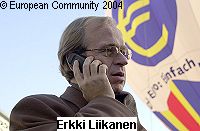
After the success of second generation (2G) mobile services, notably GSM, Europe is unquestionably a world leader in mobile communications with penetration rates of some 80 per cent. EU Commissioner for Enterprise and Information Society, Erkki Liikanen, would like it to stay that way. Despite the current leadership position, however, the emergence of a new generation of mobile communications technology means that Europe must strive to remain at the cutting edge if it is to beat off strong challenges from other parts of the world. Speaking at the Brussels launch of two new research initiatives that aim to do exactly that, Erkki Liikanen outlined the challenge facing Europe's mobile sector and described his vision for meeting it. 'The global landscape for mobile and wireless communications is [...] changing,' Mr Liikanen began. 'Several countries such a China and South Korea are investing heavily in R&D [research and development] in order to gain competitive advantage. 'That is why we cannot be complacent in the comfort of the current success of 2G mobile communications. The emergence of this new paradigm means that we need to replicate our past approach by focusing on key enablers,' he said. Those enablers include interoperability and a supportive regulatory environment for content, but at an EU level, Mr Liikanen chose to focus attention on the need for concerted action in two specific areas: research and innovation. 'Europe must focus on innovation as a key driver of competitiveness. This can only be achieved through a comprehensive programme of integrated research activities.' The Commissioner argued that today, R&D is dominated by three trends: increasing complexity, increasing interdependencies between products and services, and growing competition at a global level. 'Technology alliances and cooperation in research between companies and universities are no longer limited by national borders. The 'playground' is now international,' he pointed out. Mr Liikanen believes that a key asset for Europe is its proven capacity to pool research resources in order to achieve common goals, a strength that must be built upon. 'EU programmes have been instrumental in putting Europe on the map in critical sectors such as, for example, mobile communications. [...] It is therefore through partnership at European scale that leadership can be built. A properly funded EU-level strategic R&D programme is essential in order to achieve critical mass,' he said. Moving to innovation, Commissioner Liikanen said that the traditional model of basic research followed by applied research, development and deployment has changed, especially in the technology sector. Rather, the modern day innovation process is a strongly parallel one where all kinds of innovation interact in a multidisciplinary innovation space. 'The need to catalyse innovation by establishing large cross-disciplinary projects such as technology platforms is important for this dynamic industrial sector,' argued Mr Liikanen. 'We should encourage the development of communities which can be seen as real 'living labs' involving all research actors needed for high level research that has high impact for European growth.' Mr Liikanen concluded by reminding his audience that the Commission is hoping to adopt a communication on the mobile sector before the end of June, and offered this message of encouragement: 'The growth of high-speed mobile data services is an exciting opportunity. If grasped, we will realise enormous social and economic benefits.'