


Portugal to focus on bringing science to the marketplace, reveals Secretary of State
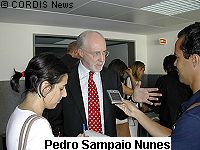
While a number of European countries debate how best to achieve EU competitiveness goals such as the Barcelona three per cent target, other nations have already accepted the reality that such ambitious aims will remain out of their reach by 2010. Portugal is one of the latter; its main focus in recent years, with the support of EU Structural Funding, has been on modernising its economy and infrastructure, rather than building a globally competitive knowledge society. Yet, given the current speed at which new industries are being created and older ones exported, there is an opportunity, and perhaps even a necessity, for Portugal to catch up quickly, provided the necessary conditions are in place. Speaking at the annual conference of the Dean European Academic Network in the northern Portuguese city of Porto, Pedro Sampaio Nunes, Portugal's Secretary of State for Science and Innovation, said that he believed Europe would reach the Lisbon goals set in 2000 at some point, and people should not get overly worried about the current rate of progress. 'During the first five years of the strategy there was too much focus on IT [information technology], and not enough on the creation of a single market in research and improving research infrastructure,' believes Mr Nunes. The Secretary of State admits that Portugal is 'struggling' with the Barcelona target, with the country's research spending currently at 0.85 per cent of GDP, and two thirds of that figure originating from public sources of funding. 'We shouldn't forget that Lisbon is not just about spending money on research, however, Europe must focus on all elements of the strategy, and it is companies, particularly small and medium sized ones, that actually create wealth and jobs.' Portugal's research and innovation policy is closely linked to the Lisbon strategy, revealed Mr Nunes, with a focus on bringing science to the marketplace. He acknowledged the importance of the Structural Funds for the country in general, and said that similarly Portugal's research structures would be reorganised towards EU programmes and funding sources. Given the small size of the country, Mr Nunes doesn't think it realistic to try and compete in all areas of research, believing that Portugal should instead focus on certain priority areas, such as IT and biotechnology. When asked to justify why these two areas in particular, Mr Nunes responded that 'these sectors are more receptive to innovation than more traditional industries, and Portugal happens to have some excellent talent in these areas at the moment.' Given that the theme of the conference was research, innovation and knowledge transfer within Europe's universities, Mr Nunes revealed that a major challenge facing higher education institutions was the need to leverage private engagement and investment in their research. 'Don't just aim for publications!' he urged the gathering of university deans. Universities play a fundamental role in the knowledge cycle, according to the Secretary of State, as the producers of new knowledge, the teachers of existing knowledge, and as key players in innovation and knowledge transfer. CORDIS News asked Mr Nunes what was most needed in order to improve the innovative performance of Portugal's universities, to which he replied: 'What we must have is more links between universities and industry, in order to transform research effort into entrepreneurial output.' Mr Nunes questioned why, when Europe is obviously struggling to get its research onto the marketplace, the major new feature of the Seventh Framework Programme (FP7) appears to be going in the other direction, with increased EU investment in basic research through the European Research Council (ERC). 'The focus should be on research-industry links!' he exclaimed. The Secretary of State concluded by reminding the conference that Europe's main weaknesses in the area of innovation do not originate in universities, but rather at the level of primary and secondary education. 'This is not due to a lack of investment, so there must be a fundamental weakness in the system.' Universities must play a role, however, by helping to promote a more scientific culture within society at large, he ended.
Kraje
Portugal