Gas hydrates under nuclear microscope

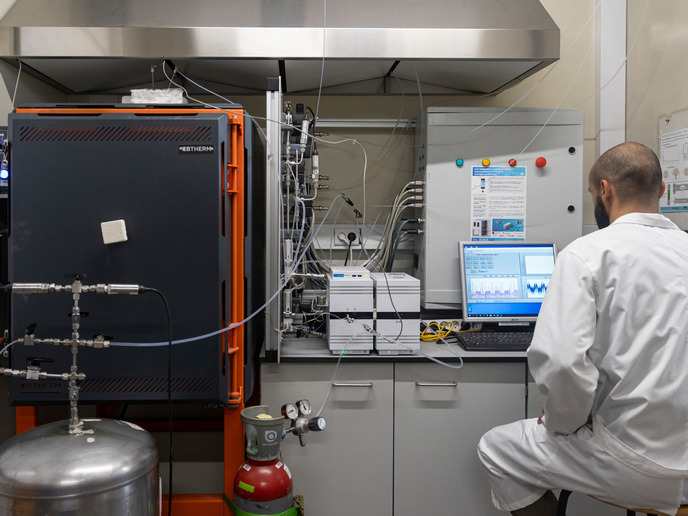
Gas hydrates form at low temperatures and high pressures in the deep sea. They contain gases, surrounded by water molecules, forming altogether a hydrate crystal. Since hydrates contain hydrocarbons, they burn easily and are attracting much interest lately as an alternative future energy source. Through the use of nuclear magnetic resonance much information can be obtained about how this interesting material forms. Recent research in this field has resulted in developing an NMR cell equipped with a precise temperature and pressure control. The method offers researchers unique, highly localized molecular information. The research carried out is part of the ANAXIMANDER project that intends to study all hydrate sites in the Eastern Mediterranean. The NMR cell manufactured has been tested extensively and with its aid the growth behavior of gas hydrates near their equilibrium condition was investigated. The studies have revealed that transport phenomena govern growth or decomposition of hydrates in porous media. It has also been noticed that there is substantial difference in hydrate's formation depending on initial gas saturation. When it is high, growth expands rapidly over large areas while when initial gas saturation is low, formation is a local phenomenon. To perform NMR measurements a non conductive material able to withstand high pressures is needed. The manufactured cell can withstand pressures up to 1000 bar. Is made out of ceramic and its core holder cell is fabricated from a silicon nitride tube. To address the problem of accurate thermostating, instead of water, researchers have used heavy water (D2O) as a coolant along with a gear pump that has a maximum flow rate of 4 liters per minute. The novel NMR cell developed is universally usable for studies on processes under high pressure and researchers seek further development support.