


Liikanen calls for greater focus on online content
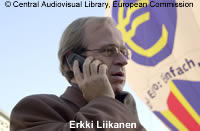
Enterprise and Information Society Commissioner Erkki Liikanen has called for a greater focus on content, services and applications to boost the number of Europeans getting online. Speaking at conference on the information society in Biel-Bienne, Switzerland, on 2 May, Mr Liikanen said that now the new regulatory framework for electronic communications is in place and due to be implemented in May 2003, attention needs to focus more on services and less on infrastructure. Internet penetration in EU households has doubled from two to four out of 10 households in the 18 months since the adoption of the eEurope 2002 action plan. But Europe 'must do better' than this, said Mr Liikanen, by shifting policy emphasis from technology and regulation to users. Content, services and applications are decisive, said Mr Liikanen. 'What people are looking for when they get online are content, services and applications which they enjoy, which simplify and improve their lives. And they must be localised, to reflect the European context with its diversity of cultures and languages.' Content must also be available through the full range of terminals, he said, including computers, mobile telephones and television sets. The European Commission's eContent programme is a step in the right direction, helping to support the development of European multimedia and multilingual content. Governments can also make a difference through the provision of public services online, or 'e-government'. Mr Liikanen said that although e-government is now a priority in all Member States, 'true interactivity is still missing.' He added that putting public services online must be accompanied by back office reorganisation and investment in human capital for real efficiency gains to be made. Mr Liikanen also outlined some priorities in ensuring full 'digital inclusion.' Schools have a key role to play in the creation of a new generation of technologically skilled citizens, he said, and technology must be integrated into the learning process. Technology can also be used to make lifelong learning available for all, he said, and boost social integration of the sick, elderly and disabled. He said that the use of commonly available Internet access points, such as television and mobile telephones, must be maximised to combat the exclusion of those who cannot afford computers.