


Busquin calls for EU to take up challenge of excellence in pharmaceutical research
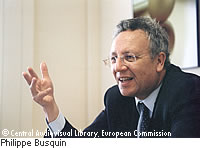
Research Commissioner Philippe Busquin has called for Europe to become a 'centre of excellence' in pharmaceutical research once more. Speaking at the annual assembly of the European pharmaceutical industry (EFPIA) in Bruges, Belgium, Commissioner Busquin said: 'I would like Europe to become a centre of excellence and a focus for pharmaceutical research once again.' He added: 'We need to nurture our research-based industries by reinforcing science and technology in Europe. Europe needs to invest more and in a better, more consistent way. It has to cut red tape and be bold.' The Commission says that although Europe has led in pharmaceutical innovation for most of the last decade, it has lost ground to the USA since 1997, when America took the lead in terms of both investment in research and development (R&D) and output of new drugs. In 1990, the EU pharmaceutical industry spent 73 per cent of its R&D budget in Europe, but this figure had dropped to 59 per cent in 1999. The USA is now spending 24 billion euro on the area compared to 17 billion euro in the EU. 'The EU has been late in grasping the potential of biotechnology for the development of new drugs,' said Mr Busquin. 'But Europe is catching up: new biotech companies are created every year in the EU. Professional technology transfer and investments in collaborative biotechnology research programmes are on the rise. Our latest Research Programme [FP6] will foster the competitiveness of the European pharmaceutical industry.' Mr Busquin warned, however, that EU funding will only have sufficient leverage if research networking efforts are backed up by both pharmaceutical companies and Member States. Enterprise and Information Society Commissioner Erkki Liikanen highlighted similar problems in the area of biotechnology, a breeding ground for the development of many new medicines. Commissioner Liikanen said the USA has a 'significant lead' over the EU in the area, with twice the number of people employed in the biotech sector, and generating twice as much revenue from it. Mr Liikanen said the EU Biotechnology Strategy, adopted in January this year, highlighted a number of deficiencies in the EU system, including gaps in the intellectual property system, weak commercial funding, a lack of synergy between biotech and supporting business and the lack of an entrepreneurial, risk-taking tradition in Europe. The Biotechnology Strategy's action plan hopes to address these problems, he said, through measures such as the introduction of an EU-wide Community Patent, and further public debate on the issue.