


Europe makes for Mars
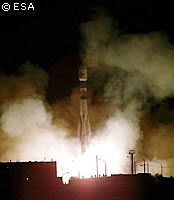
Mars Express, the first European Space Agency (ESA) probe ever to head for another planet, has been successfully placed in a trajectory that should see it reach Mars before the end of the year. The probe left Earth aboard a Soyuz-Fregat launcher, which blasted off successfully from Baikonur in Kazakhstan on 2 June. It has correctly deployed its solar panels in relation to the Sun and all onboard systems are operating faultlessly. 'Europe is on its way to Mars to stake its claim in the most detailed and complete exploration ever done of the Red Planet. We can be very proud of this and of the speed with which we have achieved this goal,' said David Southwood, ESA's Director of Science, after the launch. Following a corrective manoeuvre in two days time that will place the probe in a Mars bound trajectory, it will then begin the six month, 400 million kilometre journey travelling at over 30 kilometres per second. On arrival, Mars Express will enter an orbit around the planet in order to perform detailed studies of its surface, subsurface structures and atmosphere. It will also deploy Beagle 2, a small autonomous scientific station named after the boat that took Darwin on his voyage of discovery, which will land on the planet and take samples of the surface in an attempt to discover signs of life, past or present. The Mars Express orbiter will operate for at least one Martian year, or 687 days, while Beagle 2 is expected to work on the planet's surface for 180 days. The Mars Express mission forms part of an international Mars exploration programme which will also include two US probes and one from Japan. This first ESA mission to another planet will pave the way for other ESA led planetary missions, such as the Venus Express, planned for 2005, and the BepiColombo mission to Mercury at the end of the decade. It is also a precursor for continuing Mars missions under Aurora, the programme of exploration of our solar system.
Kraje
Japan, Kazakhstan, United States