


Group of Personalities discusses a security research strategy for Europe
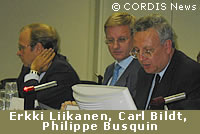
A Group of Personalities, created by the European Commission and involving two Commissioners, four MEPs, industrialists and security experts, met for the first time in Brussels on 6 October to begin discussions on the shape of a European security research programme. The European Commission has proposed a preparatory action for security research, with a budget of 65 million euro for the period 2004 to 2006, paving the way for a fully fledged programme for security research from 2007. An important aspect of this enhanced cooperation in security research will be the closer coordination of civil and military research. 'Europe is paying a very high price for the artificial, and uniquely European, separation between civil and military research,' said EU Research Commissioner, Philippe Busquin. 'New and more sophisticated security threats, combined with an increasing aspiration from citizens for security, require us to adopt a more structured and European approach to security research.' This was a point echoed by Enterprise and Information Society Commissioner, Erkki Liikanen, who claimed that 'new technologies mean that it has become more difficult to distinguish between civil and military research.' He gave examples of technology, now widely used, which were originally developed using US military research funding, including the Internet, the Windows-icons-pointer interface, and the global positioning system (GPS). The inaugural meeting was used for the discussion of principles and priorities. Member of the Group of Personalities, and former Prime Minister of Sweden, Carl Bildt, said that a general consensus had been reached on these issues, and that there was very strong support within the group 'for the basic approach taken by the Commission and for breaking down barriers and tackling new challenges.' The allocation of the 65 million euro will come later, said Mr Bildt, once the priorities have been firmly established. One area which Dutch MEP Elly Plooij-van Gorsel (also a member of the group) would like to see prioritised is research into interoperability, 'not only between systems, but between organisations as well.' Having held the position of vice chair of the Parliament's committee on the Echelon interceptions system, Ms Plooij-van Gorsel speaks from experience when she says that 'the EU is not so good at coordination. [...] We have 14 intelligence agencies [in all Member States except Luxembourg] and they never cooperate.' She told CORDIS News that 'people complain about too little money, but the Member States have illustrated that they don't want to coordinate.' The preparatory action will involve launching a series of research activities supporting European security issues, establishing a consultation and consensus building platform to develop a long term vision, and demonstrating that the Community can respond with appropriate actions to some of the immediate challenges faced by Europe. Specific subjects that may be addressed include interoperability; crisis management; security in a distributed environment; protection of vital public and private infrastructure; protection against incidents with bio-chemical and other substances; technologies for situation awareness; and non-lethal means to counteract terrorist actions. No offensive weaponry will be developed under the initiative. Although funding percentages for the EU and industry have not yet been agreed, the Commission is likely to contribute more than it does to individual projects under the Sixth Framework Programme, the justification being that this research will be mission driven rather than technology driven. Mr Busquin also wished to emphasise that 'European research policy is not just the Framework Programmes, it's larger. We want to identify what is needed from European research in the field of security.' The next step towards a European security research strategy will be the publication of a Commission communication in November. Once this has been approved, the first calls for proposals are expected to be launched in 2004. The Group of Personalities will submit their conclusions by spring 2004. Meanwhile, the results of a study by the Commission's Joint Research Centre (JRC) were published on 6 October, indicating that new technologies introduced since 11 September have enforced search and seizure powers and are putting at risk the right to privacy of individual citizens. The JRC identifies a number of areas where policy action may be needed, such as identity theft; private-sector databases; private-public sphere indicators; and technology-specific regulation. However, the JRC also claims that while the study revealed some concerns, it also underlined that technology can help to enhance protection of personal data and increase transparency in security processes.