


ESA member states give backing to Ariane
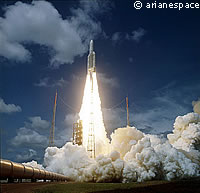
The member states of the European Space Agency (ESA) have agreed to release extra funds to support the Ariane 5 programme and prepare for the development of future launchers. The decision to provide extra financial backing for the Ariane 5 rocket, which has recently had to overcome technical difficulties and a downturn in the global launcher market, was taken unanimously during an ESA Council meeting in Paris on 4 February. The ESA Council agreed to release 960 million euro of funding for the European guaranteed access to space (EGAS) initiative, which will essentially support Arianespace in its continued production of the generic Ariane 5 launcher. Furthermore, an initial 24 million euro budget for concept studies for a new post-Ariane 5 launcher for Europe was also approved. ESA Director General Jean-Jacques Dordain said: 'Europe can today fly high: we have a launcher which is highly appreciated worldwide and the preparation of future developments is now a reality. [...] Once more, when Europe's future is on the line, the member states are able to find the energy to overcome the difficulties, coming up with the right solutions at the right time.' The ESA Council also approved a cooperation agreement with Russia to establish a 'Soyuz at the Guiana space centre' programme. The agreement will see the Russian built rockets taking off from ESA's base at Kourou in French Guiana under Arianespace's operation. ESA and Russia have also agreed to establish joint activities in the development of future launchers. On the same day, ESA also announced that it had selected a name for the lander that it hopes will touch down on Comet Churyumov-Gerasimenko after a ten year journey on board the Rosetta spacecraft. The lander will be called 'Philae', after the island in the river Nile where an obelisk was discovered that helped French Egyptologist Jean-François Champollion decipher the hieroglyphs on the Rosetta Stone, and thus unlock the secrets of the ancient Egyptian civilisation. The name was selected after a competition in each of the main contributing countries to the development of the lander. The winning suggestion was suggested by 15 year old Serena Olga Vismara from Milan, Italy.