


ESA prepares for mission to Mars
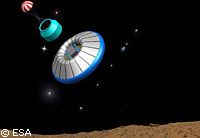
Undeterred by the apparent failure of the UK's Mars probe Beagle 2, the European Space Agency (ESA) is looking ahead to 2009, the date foreseen for the launch of the ExoMars rover and its Pasteur payload of scientific instruments. A major step towards the realisation of the ambitious robotic programme has now been made, with the selection of two industrial teams to carry out the detailed design of the rover and payload. The rover will be the first vehicle of its kind to be built by ESA. 'In addition to defining the optimum conceptual design for the rover, [the industrial groups] will also be expected to consider the unique operational environment on Mars. The studies will also take into account the design of the Pasteur payload and how the scientific instrument package can best be integrated with such a highly mobile vehicle.' The two consortia bring together companies from the UK, Italy, Germany, France and Canada. ESA has also issued a 'call for ideas', requesting proposals from the scientific community on what instruments should make up the Pasteur payload. Some 50 proposals from more than 600 scientists in 30 countries have been received, and three working groups will now be charged with the difficult task of sorting through the proposals and advising on the final composition of the payload and its utilisation on Mars. 'Our intention is to define a multi-instrument package that will be able to fulfil a number of key tasks,' said Jorge Vago, a scientist working on ExoMars. 'It should be able to drill into the surface, retrieve and analyse samples, study the physical environment and look for evidence of biomarkers - clear signs that life has existed on Mars in the past, or even survives to the present day.' The rover will also seek to identify potential obstacles to human missions to Mars by measuring, for example, the chemical composition of rocks. ExoMars will include an orbiter and a descent module. After releasing the lander, the orbiter will operate as a data relay satellite between the Earth and the rover.