


Council discusses initiatives to strengthen European research and nanotechnology
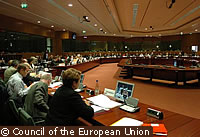
Meeting on 24 September, the EU Competitiveness Council adopted conclusions calling for continuity between the Sixth and Seventh Framework Programmes, but with initiatives to simplify procedures. Ministers also stressed the need for the reinforcement of nanotechnology research at European level. The Council reviewed the findings of an expert panel charged with carrying out a mid-term evaluation of the new instruments of the Sixth Framework Programme (FP6) and endorsed its findings. The main conclusions of the review were that the new instruments and their aims are justified, but that more needs to be done to ensure that smaller and less experienced entities are able to participate in the programmes and that the instruments are correctly understood. Ministers stated that both new instruments - Integrated Projects and Networks of Excellence - should continue to be used in FP7, but that the more traditional 'specific targeted research projects' (STREPs) should continue to exist alongside them. The Council conclusions also welcome the Commission's stated intention to introduce corrective measures, principally in relation to clarifying the objectives of the new instruments and what is meant by 'critical mass', improving participation by industry, small and medium sized enterprises (SMEs) and entities from the new Member States, and improving procedures for consortia building and proposal submission. The conclusions also emphasise the need for the Commission to consider other corrective measures, in particular in relation to the simplification and improvement of administrative and financial procedures, when drawing up proposals for FP7. The Competitiveness Council will hold what is termed as 'an in-depth debate' on the future of European research policy at its next meeting on 25 and 26 November, but in the meantime has underlined the need for further reflection and clarification on how existing horizontal themes should be dealt with in FP7. These themes include: the openness of the Framework Programme to the rest of the world; encouraging and facilitating industrial participation, in particular by SMEs; improving relations between science and society; supporting the EU's policies through research and innovation; and the role of industrial innovation and competitiveness as drivers for the design and implementation of research activities. Ministers also reiterated their desire to see a closer relationship between the EU research programmes and other European initiatives such as Eureka and COST. Nanotechnology was under discussion in the light of a recent Commission communication on a European strategy for nanotechnology. Ministers emphasised the important potential of nanosciences and nanotechnologies in areas such as health care, information technologies, materials sciences, manufacturing, instrumentation, energy, environment, security and space, and thus their significance for quality of life, sustainable development and competitiveness. The Council endorsed the main thrust of the communication, namely the need to develop an integrated and responsible strategy, and called for this strategy to be coherent and coordinated so as to ensure efficiency, effectiveness, synergy, the concentration of efforts, critical mass and visibility. The Council invited Member States to reinforce their national research in the field of nanotechnology, while inviting the Commission to draw up an action plan for nanotechnology following a stakeholder debate. The Commission was also asked to engage in an international dialogue with a view to establishing a framework of shared principles for the safe, sustainable, responsible and socially acceptable development and use of nanotechnologies.