


European Space Council prepares ground for common space programme
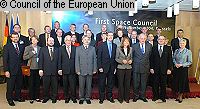
The first ever European Space Council took place on 25 November, and was widely acclaimed as the first step towards a European space policy and eventual programme. The meeting brought together ministers from the 27 countries that are members of the European Union and/or the European Space Agency (ESA), as well as representatives from the two bodies. While priorities and specific areas of cooperation were not discussed, the scene was set for negotiations of this kind, which will take place at the next two meetings, planned for spring 2005 and autumn/winter 2005. Chair of the Council Laurens-Jan Brinkhorst, Dutch Minister for Economic Affairs, said after the meeting that some political challenges need to be resolved before the establishment of a European space programme, for example in relation to scope, division of roles, industrial policy and financing. He said that orientation has been agreed, however, and that the focus will be on areas such as applications, infrastructure, science and governance. Asked whether he would like to give an indication of specific areas where cooperation between the EU and ESA might be envisaged, Günter Verheugen, who now has space in his portfolio as Commissioner for Enterprise and Industry, claimed that while he does have a number of ideas on the topic, politically it would not be wise to talk about them at this point. He did say, however, that Europe's space policy must be user-oriented, and must serve current and future needs, for example in the fields of transport, the environment, defence and security. He added: 'It is my firm belief that, in addition to continuing and extending research, our space activities should be extended beyond research. Space is an area that goes far beyond research.' Mr Verheugen also said that the level of resources invested in space in Europe is currently limited, and that he intends to address this immediately. He added, however, that calls by former Research Commissioner Philippe Busquin for annual investment of one billion euro is 'not realistic today', and that funding of this magnitude was not foreseen in the Commission's financial perspectives. The relationship between the EU and ESA was raised at the briefing following the Council. Jean-Jacques Dordain, Director-General of ESA, emphasised that 'ESA does not wish to impinge on the role of others,' and that 'the Commission is also going to use ESA for areas it knows best, such as launchers.' Mr Verheugen echoed this point, stating that 'ESA is not under the direction of the EU. We are partners. I don't believe we're in different camps. Both of us find it intelligent to share information and ideas.' Attending the Council in her capacity as current chair of the ESA council, German Minister for Education and Research Edelgard Bulmahn also alluded to the strengths that both bodies bring to the partnership. She referred to ESA's technological competence, and said that now is the time to put this to use to meet political goals. Ms Bulmahn also put particular emphasis on the need for space policy to be considered as different to other industrial policies, and the resulting need to draw up a different set of rules to govern it. The minister also referred to the need to 'not mix up the financing of the EU and ESA. While both joint projects to date, Galileo and GMES (global monitoring for the environment and security) have involved funding from both bodies, Ms Bulmahn said that there must be clear responsibility for each joint project, including in relation to finance. 'Otherwise we won't increase efficiency,' she said.