Unlocking the secrets of gas hydrate chemistry

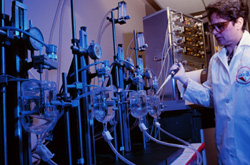
Gas hydrates have been discovered at a number of locations throughout the world's oceans and seas. The exact nature of their formation and interaction with other elements of the deep biosphere is not well understood. The Energy, Environment and Sustainable Development Programme funded the seven members of the ANAXIMANDER project to unravel some of the mystery surrounding gas hydrates. The Technical University of Crete was responsible for trying to reproduce the unique gas hydrate chemistry in the laboratory. The central component of their experimental rig is a pressurised vessel known as an autoclave. Two pistons balance the amount of liquid and gas in the chamber in order to maintain constant pressure. Mixing is performed by a magnetic stirrer while two ports enable simultaneous sampling of the two phases, gas and liquid. Data on pressure, displacement volume and flow are also collected and sent to a computer for analysis. The Greek scientists used the set-up to study the formation of gas hydrates from multi-component gases in non-saturated conditions. They tinkered with the stirring rate, transition and formation times in order to determine their relative influence on thermodynamic stability. They subsequently learned that equilibrium can be reached within approximately three days.